Mary Naegeli:
What if one year in one book allowed one story to shape your one life? Good morning. My name is Mary Naegeli and I’m a pastor in partnership here at WCPC. It’s my pleasure to join Jeremy in reading today’s scripture, which is found in the book of Second Kings, chapter 5, verses 1 through 16. Hear the word of the Lord.
2 Kings 5:1–3 (NIV)
1 Now Naaman was commander of the army of the king of Aram. He was a great man in the sight of his master and highly regarded because through him the Lord had given victory to Aram. He was a valiant soldier, but he had leprosy. 2 Now bands of raiders from Aram had gone out and had taken captive a young girl from Israel. And she served Naaman’s wife. 3 She said to her mistress, “If only my master would see the prophet who is in Samaria, he would cure him of his leprosy.”
Jeremy Howard:
2 Kings 5:4–8 (NIV)
4 Naaman went to his master and told him what the girl from Israel had said. 5 “By all means, go,” the king of Aram replied. “I will send a letter to the king of Israel.” So Naaman left, taking with him ten talents of silver, six thousand shekels of gold and ten sets of clothing. 6 The letter that he took to the king of Israel read: “With this letter I am sending my servant Naaman to you so that you may cure him of his leprosy.” 7 As soon as the king of Israel read the letter, he tore his robes and said, “Am I God? Can I kill and bring back to life? Why does this fellow send someone to me to be cured of his leprosy? 8 See how he is trying to pick a quarrel with me!” When Elisha, the man of God, heard that the king of Israel had torn his robes, he sent him this message: “Why have you torn your robes? Have the man come to me and he will know that there is a prophet in Israel.”
Mary Naegeli:
2 Kings 5:9–13 (NIV)
9 So Naaman went with his horses and chariots and stopped at the door of Elisha’s house. 10 Elisha sent a messenger to say to him, “Go, wash yourself seven times in the Jordan, and your flesh will be restored and you will be cleansed.” 11 But Naaman went away angry and said, “I thought that he would surely come out to me and stand and call on the name of the Lord his God, wave his hand over the spot and cure me of my leprosy. 12 Are not Abana and Pharpar, the rivers of Damascus, better than all the waters of Israel? Couldn’t I wash in them and be cleansed?” So he turned and went off in a rage. 13 Naaman’s servants went to him and said, “My father, if the prophet had told you to do some great thing, would you not have done it? How much more then, when he tells you, ‘Wash and be cleansed’?”
Jeremy Howard:
2 Kings 5:14–16 (NIV)
14 So he went down and dipped himself in the Jordan seven times, as the man of God had told him, and his flesh was restored and became clean like that of a young boy. 15 Then Naaman and all his attendants went back to the man of God. He stood before him and said, “Now I know that there is no God in all the world except in Israel. So please accept a gift from your servant.” 16 The prophet answered, “As surely as the Lord lives, whom I serve, I will not accept a thing.” And even though Naaman urged him, he refused.
Mary Naegeli:
The grass withers and the flowers fall, but the word of our God endures forever.
Bart Garrett:
Well, thank you so much, Jeremy and Mary. I’m going to just be real. Whenever you guys read scripture, I confess my envy. Like, I want to read like these two. It’s amazing. Maybe it’s just me.
Welcome, everyone. If we haven’t met, I’m Bart Garrett, the lead pastor here. And we’ve been making much of the one nature of this story, talking about how scripture in one year really does shape our lives with this one story. And we’ve kind of been doing this flyover topography of all things big. We’ve talked about creation, we’ve talked about the flood, we’ve talked about slavery in Egypt and this massive deliverance through the Red Sea. And yet here’s this little vignette tucked away in the stories of the kings.
Why are we talking about this particular story? Well, firstly, it’s one of my favorite stories in the Hebrew scriptures. And secondly, we’ve been talking about how there are brilliant and beautiful patterns and paradigms in our scripture. And this story is a paradigm of paradigms. How God works with people, healing, salvation, deliverance, rescue. It’s all there.
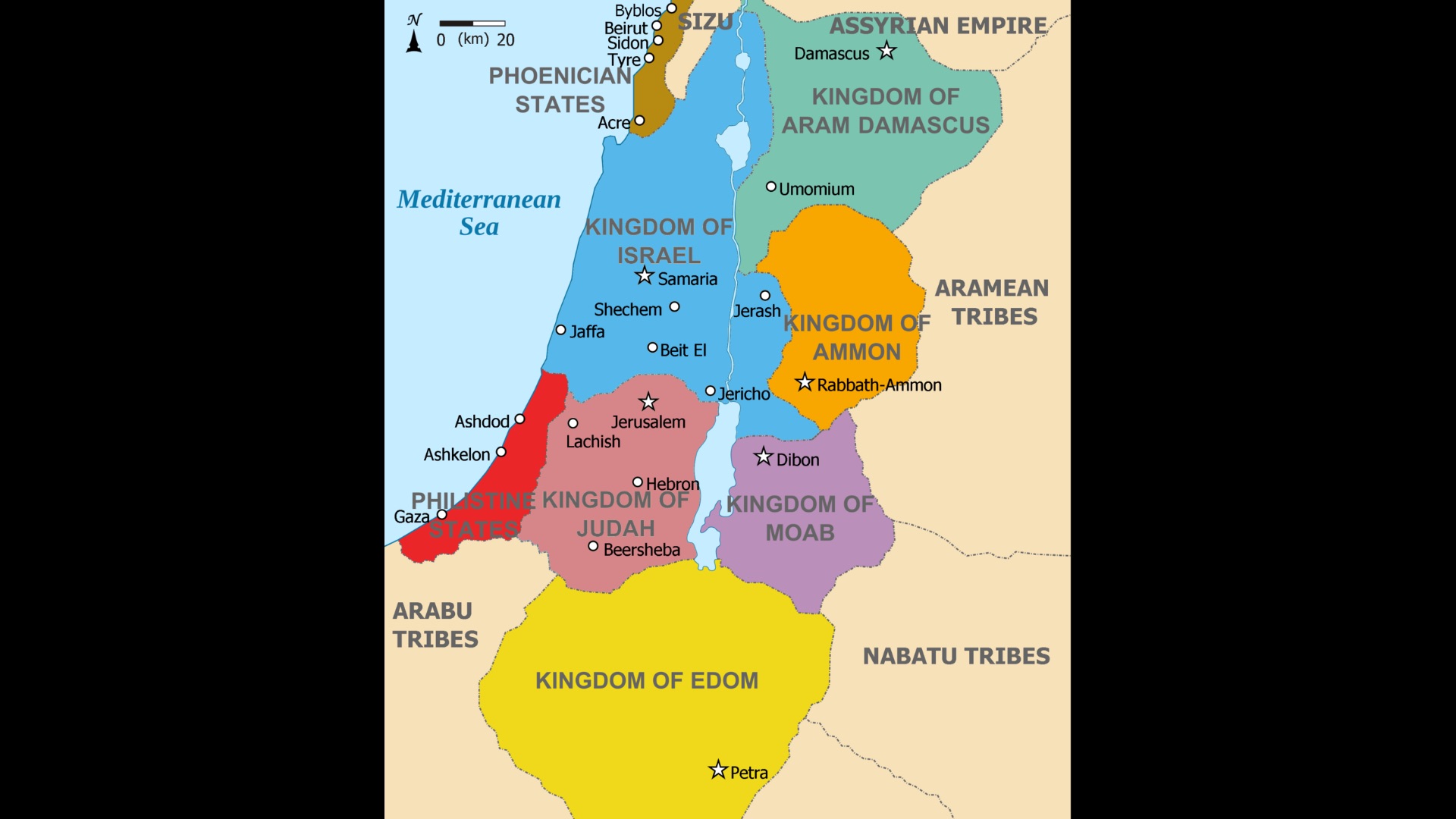
And to just give you the historical setting for just a moment, it’s the 9th century BC and clans and tribes have given way to the rise of kingdoms. So the last couple weeks, we’ve talked about the rise of King David and the many battles fought with the Philistines. But now, and to point out on this map, there’s been this civil war. So there’s now the kingdom of Israel and the kingdom of Judah, and this northern kingdom, Israel is battling with Aram, which is modern day Syria. And these kingdoms are in constant conflict. There are border raids and shifting treaties and small skirmishes. And it explains why this young Israelite servant girl is in Naaman’s house. She’s this likely captive.
And we meet Naaman, who’s the commander of the Syrian army. He’s this great man, he’s highly favored. He’s this valiant soldier. He would be like a five star general in our day, but he has leprosy, which in that day would be untreatable. And this unnamed servant girl offers an unlikely solution and becomes this unexpected conduit of God’s healing grace. Again, this is a paradigm of paradigms for salvation and rescue.
And like God often does, he subverts all of culture’s dominant paradigms. And so she says, I know where you can go to get help. And this story, I think, is so relatable because most all of us seek to shape a life that is both successful and comfortable. We want to be happy, we want to be free. We want to be secure. We optimize for it. We want stability in our family and in our friendships. We want some travel and some leisure. We want to sprinkle in a little bit of fun and a little bit of adventure. We mix in some recognition and some accolade and some accomplishment and achievement. Can this be too much to ask in a life?
So we can kind of relate to Naaman? He’s a good man. No, he’s a great man. He’s valiant, he’s favored, he’s successful, he’s wealthy, he’s powerful. Verse one. But he had leprosy. His life is starting to fall apart. And in that day he would be considered unclean and defiled. He’d be isolated, he’d lead an impending death where his flesh would quite literally rot away. And he would be alone and afraid.
In whatever designer life that I’ve created or you’ve created, there will always be a suddenly, the plot twists, the story turns. There will always be a but he had. It can come from the outside. Financial reversal, relational betrayal, anguishing loss. No amount of comfort or success can keep it away. Or it can come from the inside. All of a sudden, or a little bit at a time, your body stops working. Something is askew. There are doctors and tests and prescriptions.
And let me just pause right here to acknowledge in this room the moment of fear and anxiety that something like this produces. For the first time, maybe some of us begin to feel out of control. And in moments like this, many of us, or most of us, or even all of us can first be like Naaman. We don’t start seeking God until something starts going terribly wrong in our lives. And still, when we need help or healing, seeking God can kind of be the last ditch effort, the final option on a really long list that I’ve tried everything moment.
And I want to offer this humbly and hopefully you’ll allow it because I’m a pastor after all. But this story has both the potential and the power to save you from the I’ve tried everything and nothing is working kind of a life when it comes to receiving healing, deliverance, rescue, salvation, whatever you want to call it.
Here’s the big idea. There’s society’s solution and there’s God’s solution. And we see both of them in this story. First, society’s solution. I pick it up again at verse four.
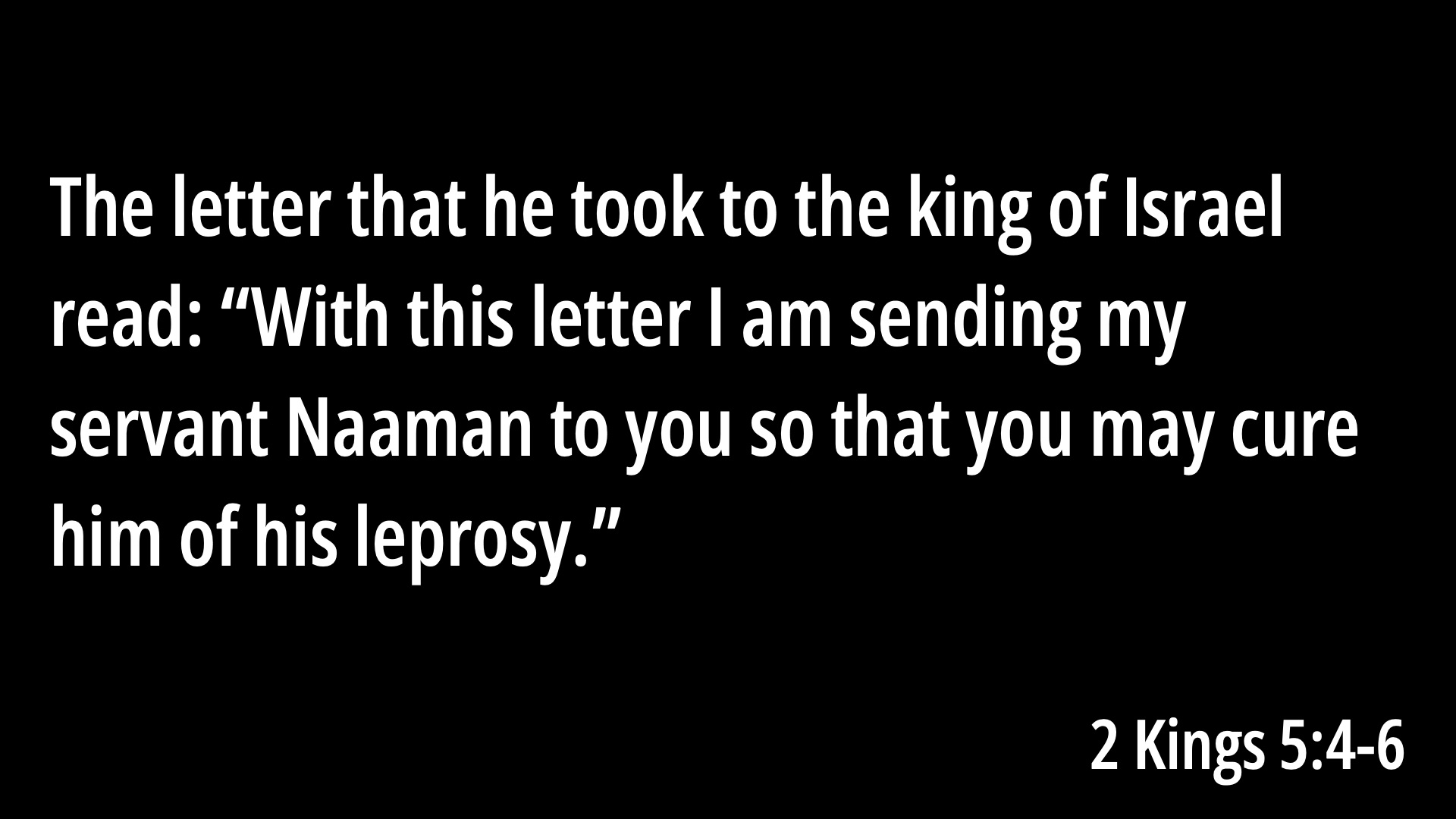
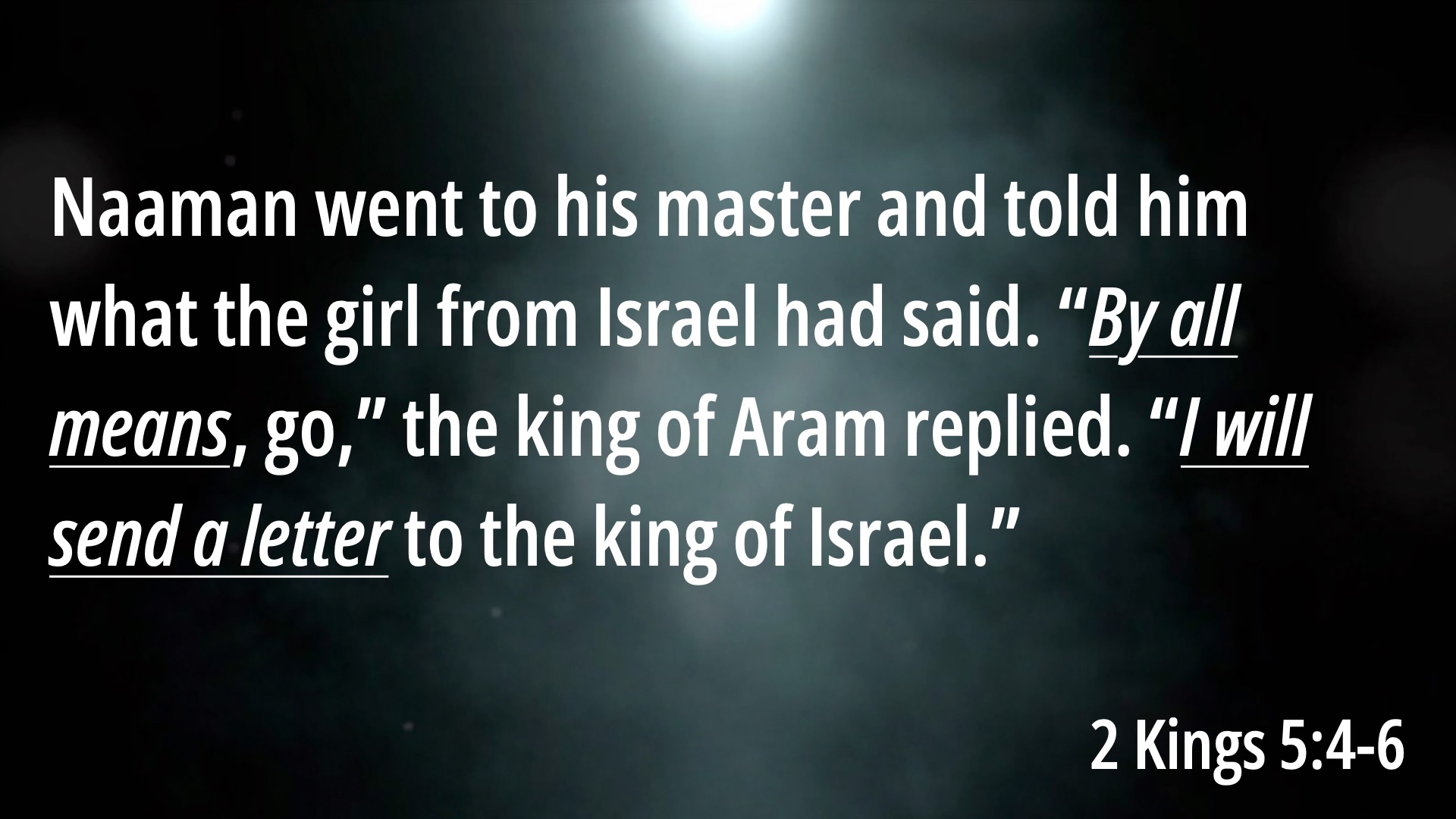
Naaman went to his master and told him what the girl from Israel had said. By all means go. The king of Aram replied, I will send a letter to the king of Israel. So Naaman left, taking with him 10 talents of silver, 6,000 shekels of gold and 10 sets of clothing. The letter that he took to the king of Israel read, With this letter I am sending my servant Naaman so that he might be cured of his leprosy.
So first we see that Naaman is desperate. After all, he’s seeking the God of Israel. And you should know, Israel was losing the war. So why would the loser country’s loser God have anything for Naaman? It’s shocking. But Naaman is desperate. He’s armed with society’s solution. Did you catch it? By all means. They’re going to throw everything in the kitchen sink at this issue.
So Naaman has connections to people at the top. He goes from one king to another. Notice in the story both of the kings are unnamed because this is the every story. Secondly, Naaman has an enormous amount of money and wealth. Thirdly, he has power, he has expertise, he has prowess. And this is very important. Don’t miss this. He assumes that this nation and its God are like every other nation and their God in that day. Because every nation had a God who by extension was doing their bidding. It was the nation that was controlling the God. The God was under the national, political, cultural control of the day.
And as a pastor, let me tell you one of my deepest lamentations that we in America can pledge one nation under God and live as God under one nation. See, politicians, I think today are using Christians. They throw in just enough godspeak, draping the nationalism so we can be duped into doing their bidding. But I pray the church will not be duped and I know God will not be mocked and that’s what this story is all about.
Naaman goes to the king because he assumes the king is the employer of the God, the employer of the prophet. The prophet is just a puppet on a string. So verse seven, as soon as the king of Israel read the letter, he tore his robes and said, am I God? Can I kill and bring back to life? Why does this fellow send someone to me to be cured of his leprosy? See how he is trying to pick a quarrel with me?
So see, the king of Israel is afraid that this might launch some sort of international incident. But more than that, he knows that Naaman is coming to the one place in the world where prophets are not on a string and where God doesn’t do what God’s told. God is not the projection of our culture and our desires. And God is the judge of our culture and our desires.
This is a moment, I think, right here in this room and right in this story. It’s an opportunity for us to see that society’s solutions, connections, money, power, politics, society’s solutions may help you, but they can’t ultimately heal you. Until you recognize this, you may not make much spiritual progress in life. Yet when you start to see it, you just might become aware of God’s solution.
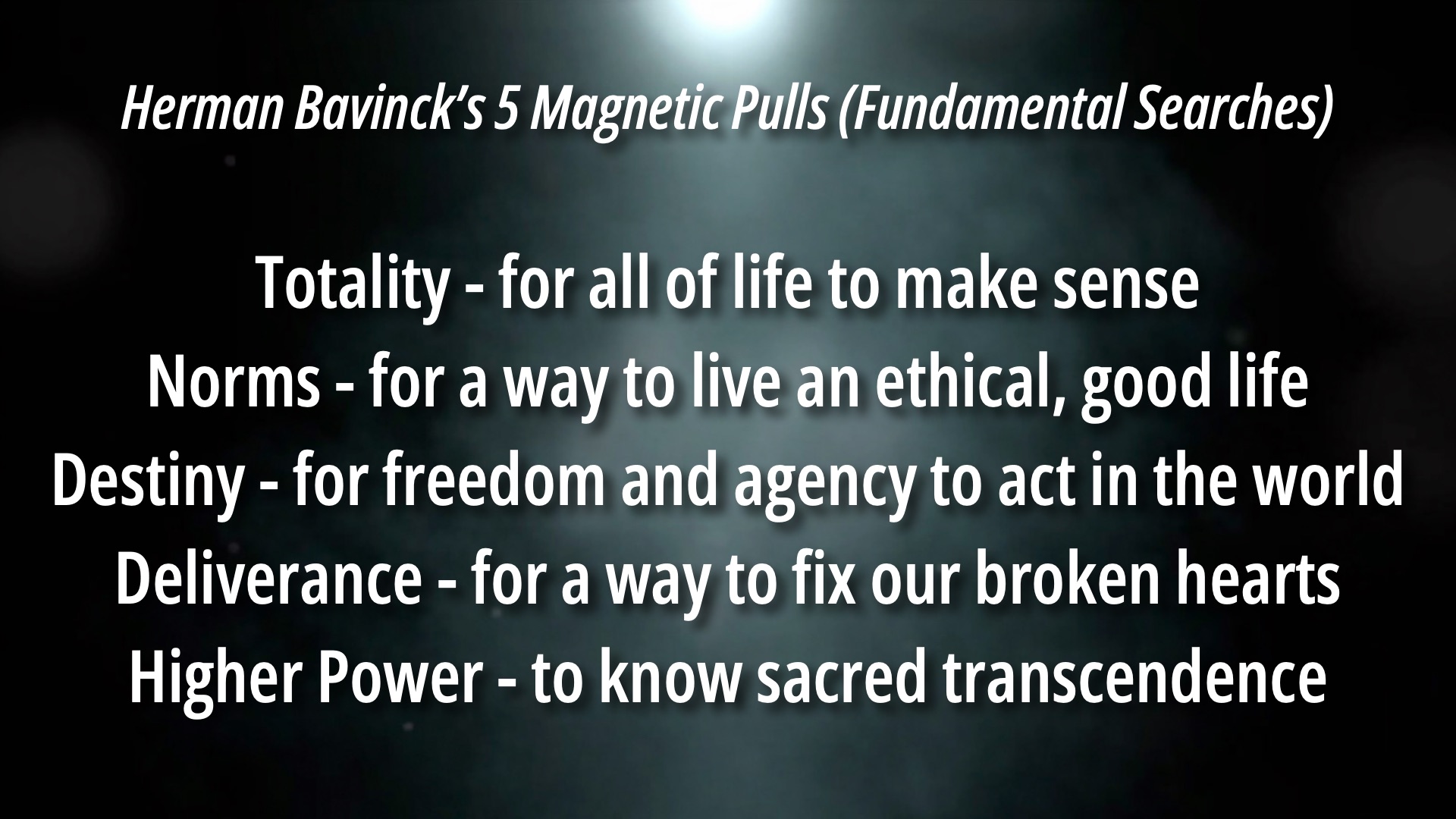
Our second point, the final point here, some of you might know the work of Hermann Bavinck. He’s this Dutch theologian, philosopher, and he’s had a renaissance of late because a lot more of his work has been translated into English. And he talks about five fundamental searches of all human beings, and he calls them the five magnetic poles. And here they are. One is totality. It’s a search for all of life to make sense, to try to figure life out. A second search we all have is for norms, for a way to live an ethical good life. A third search we all have is for destiny. We want freedom and agency to act in the world, to make a difference in the world. A fourth search is for deliverance, for a way to heal and to fix our broken hearts. And the fifth search is for higher power, is to know the sacred transcendence.
All of us have these five magnetic poles. And I believe these last two are especially inextricably linked because we know deep down that our hearts are broken and we need some sort of deliverance, salvation, healing, rescue. Whatever you want to call it. And so we lunge for and we look to God. In moments like this, we ask, is there any way to fix our broken hearts? Is there a way out? And I say, yes, but it’s actually a way in, into the deepest places in your hearts where you begin to more fully recognize your predicament, your desperation. You see your but he had moments. And then you might see that your but he had moments are connected ultimately to the reality that we all face an impending death.
And death is deeply connected to the totality of what’s actually gone wrong with this whole show. We’ve talked about it a lot this year, where our story begins in the garden, where our turning away from God, the higher power, the sacred transcendence, has set the whole world off kilter. It’s introduced all of the pain and sorrow and suffering and grief and regret and anguish. And all of this is deeply attached to this severe ache of being separated from God, to be created, to be connected to God, yet to be mercilessly disconnected from God.
And I think this is the shift, this is the turn from merely wanting help, from suffering, as noble and natural and right as that impulse may be, to wanting and needing forgiveness of our own sin, our own part in turning away from God. And this is also, I think, the shift, the turn in the story. When Elisha says, after the king tears his robes in verse 8, have the man come to me. This is where he’s going to learn of a true prophet, a true God, the bearer of truth, who will offer the only hope of this world.
So verse nine, I pick it up. So Naaman went with his horses and his chariots and stopped at the door of Elisha’s house. Elisha sent a messenger to say to him, go wash yourself seven times in the Jordan and your flesh will be restored and you will be cleansed. So notice again, Naaman goes with his horses and his chariots because it’s so hard to part with the world’s solutions. And what does Elisha do? Elisha stiffs him. It’s an attack on his pride. He doesn’t even go out to him. He only sends instructions. Go and wash yourself seven times.
This is a picture, the number seven, of full cleansing more deeply. It’s about a reconciliation with God that will restore a relationship with God. And this is a moment, I think, for us to see that life keeps coming at us. Life keeps coming at you and it will continue to pulverize you and shatter you until you begin to experience that right relationship with God is more important than anything else. Then, and only then, can you handle anything yet we’re stubborn, aren’t we? We keep incessantly fighting against God’s solution. We keep bringing our horses and our chariots to the equation.
So verse 11. Naaman goes away angry and sad. I thought he would surely come out to me and stand and call on the name of the Lord and wave his hand over the spot and cure me of my leprosy. Are not Abana and Pharpar, the rivers of Damascus, better than all the waters of Israel? Could not I wash in them and be cleansed? So he turned and went off in a rage.
Naaman’s servants went to him and said, my father, if the prophet had told you to do some great thing, would you not have done it? How much more then when he tells you, wash and be cleansed? So in his haughty rage, his servants know that Naaman still wants some sort of pomp and circumstance. The fog machines, the laser shows. Maybe he’s thinking, if I cannot buy a cure, perhaps I can earn a cure. I can do some great thing. I can do some great deed. Elisha’s going to tell me, find the last Horcrux or bring me the head of Thanos something. But wash seven times in the Jordan River. He’s enraged. Any idiot can do that.
But the great thing is you can’t do any great thing. Someone will ultimately need to do the great thing for you. See, cleansing in the Jordan is deeply symbolic. In fact, it’s the river that the people of God crossed as they entered into the promised land, which was its own paradigm, its own pattern. When John the Baptist was preparing the way for Jesus, he offered baptisms, these cleansing rituals in the Jordan River. And as Jesus is coming to be baptized, he says, this is the sacrifice. Behold the Lamb of God who will take away the sins of the world. This is a foreshadowing that the truest, deepest, fullest cleansing would be the blood of Jesus’ loving sacrifice.
As the old hymn goes, what can wash away my sin? Nothing but the blood of Jesus. What can make me whole again? Nothing but the blood of Jesus. And I recognize as I’m saying this that this could be a big leap for some of you that are here this morning. Wait, wait, wait a second. We’ve gone from water to blood to sacrifice, to atonement, for cleansing and for healing.
But imagine for a moment explaining Wi-Fi to Benjamin Franklin. You’re saying, yes, it’s true. These invisible waves fly through the air, carrying cat videos to all of our glowing rectangles that we keep in our pocket. I would say to Benjamin Franklin, don’t shy away just yet from doing the work of understanding. You’re smart. You can get this. And I would say don’t shy away from doing the work of sacrifice and cleansing and atonement. We have many resources and explanations. Your pastors want to give you tools for the journey. We would love to walk with you as you ask these questions, but suffice it to say, right here and right now, the deeper we sink into the story of Jesus, the more we begin to recognize that we cannot earn salvation, deliverance, rescue, healing, whatever you want to call it. It’s a gift of God’s amazing grace. Unvarnished, unbarnacled, unadorned, sheer amazing grace.
So finally, verse 14, Naaman went down and dipped himself in the Jordan seven times, as the man of God told him, and his flesh was restored and became clean like that of a young boy. Then Naaman and all his attendants went back to the man of God. He stood before him and said, now I know there is no God in all the world except in Israel, so please accept a gift from your servant. The prophet answered, as surely as the Lord lives whom I serve, I will not accept a thing. And even though Naaman urged him, he refused.
So there’s no God in all the world except in Israel is this breathtaking decree made by a Syrian general. And it’s actually another paradigm, another pattern that this God transcends all cultures. And there’s an amazing prequel and an amazing sequel to this story. Even Jesus in the Gospels talks about Naaman as the paradigm of paradigms, not just for Israel, but for the whole world. But that’s a teaser. We don’t have time to talk about that today. We have a preacher P.S., it’s the second podcast where we riff on the sermon for a few minutes. Spoiler. I want to get a little bit into the prequel and sequel and Jesus’ words about the story because they are amazing.
But here, as we conclude, I simply want to point out Naaman keeps struggling with God’s free grace because it is so hard to accept. Did you catch it? Let me give you a gift. Please take this as exchange. I will not accept a thing. Why? Because God’s cleansing costs nothing. We see it in the baptisms we do here that God buries our old lives and raises us up from the dead. We come not with good works, but with leprosy. Not with hands full of connections and money and power, but empty handed.
So what about you? As we conclude, maybe there are two sets of people in the room because I know how much all of you love being labeled. But maybe there are those who are still pursuing society’s solutions for healing, and maybe there are those who are still struggling, maybe for years now with the sufficiency of God’s grace in your life. So I want to say a quick word to each of us.
First, to the first group. This week I opened my Bank of America app, which I do two or three times in any given week. And I noticed something for the very first time that I’ve never noticed before. A quote question underneath the logo. This is what it said at the top of my app. What would you like the power to do? I’ll tell you. To live forever, to never age, to have no health concerns, to have every relationship that’s askew in my life repaired. To lose no one that I love. For my work to matter, to extend beyond the grave. I want the power to heal, rescue, save, and deliver myself. But it’s never going to happen with my bank account, with my connections, with my prowess. And I think that’s true for you, too.
So if you’re still trying on the world’s solutions and they’re not working, the only thing you have to give is in surrender to the work of Jesus in your life. And then for the second group of us, maybe you’re a church person who’s been doing this for decades, and you just can’t receive God’s grace being good enough and strong enough for you because you’re saying, pastor, you don’t know what I’ve said, where I’ve been, what I’ve done. So what if the one great thing left in your life is to have the humility to trust God, to do for you what you cannot do for yourself? That’s grace that God has the power to heal. Even me.
In the name of the Father, Son and Spirit, we pray. Amen.