Tommy Branagh:
Our scripture reading this morning comes from the Book of Ruth.
Ruth 1:22–2:12 (NIV)
22 So Naomi returned from Moab accompanied by Ruth the Moabite, her daughter-in-law, arriving in Bethlehem as the barley harvest was beginning. 2:1 Now Naomi had a relative on her husband’s side, a man of standing from the clan of Elimelech, whose name was Boaz. 2 And Ruth the Moabite said to Naomi, “Let me go to the fields and pick up the leftover grain behind anyone in whose eyes I find favor.” Naomi said to her, “Go ahead, my daughter.” 3 So she went out, entered a field, and began to glean behind the harvesters. 4 As it turned out, she was working in a field belonging to Boaz, who was from the clan of Elimelech. 5 Just then, Boaz arrived from Bethlehem and greeted the harvesters. “The Lord be with you!” “The Lord bless you!” they answered. 6 Boaz asked the overseer of his harvesters, “Whose young woman is this?” 7 The overseer replied, “She is the Moabite who came back from Moab with Naomi. 8 She said, ‘Please let me glean and gather among the sheaves behind the harvesters.’ She came into the field and has remained here from morning till now, except for a short rest in the shelter.” 9 So Boaz said to Ruth, “My daughter, listen to me. Don’t go and glean in another field and don’t go away from here. Stay here with the women who work for me. 10 Watch the field where the men are harvesting, and follow along after the women. I have told the men not to lay a hand on you. 11 And whenever you are thirsty, go and get a drink from the water jars the men have filled.” 12 At this, she bowed down with her face to the ground. She asked him, “Why have I found such favor in your eyes that you notice me, a foreigner?” Boaz replied, “I’ve been told all about what you have done for your mother-in-law since the death of your husband. How you left your father and mother and your homeland and came to live with a people you did not know before. May the Lord repay you for what you have done. May you be richly rewarded by the Lord, the God of Israel, under whose wings you have come to take refuge.”
The grass withers and the flowers fall, but the word of our God endures forever.
Mary Naegeli:
Thank you. Good morning, everyone. My name is Mary Naegeli, and I’m a pastor in partnership here at Walnut Creek Presbyterian Church. As a daughter, a mother, and a grandmother, I have the privilege of preaching on Mother’s Day for the first time in years. I can’t even remember actually the last time, so I want to have a little fun.
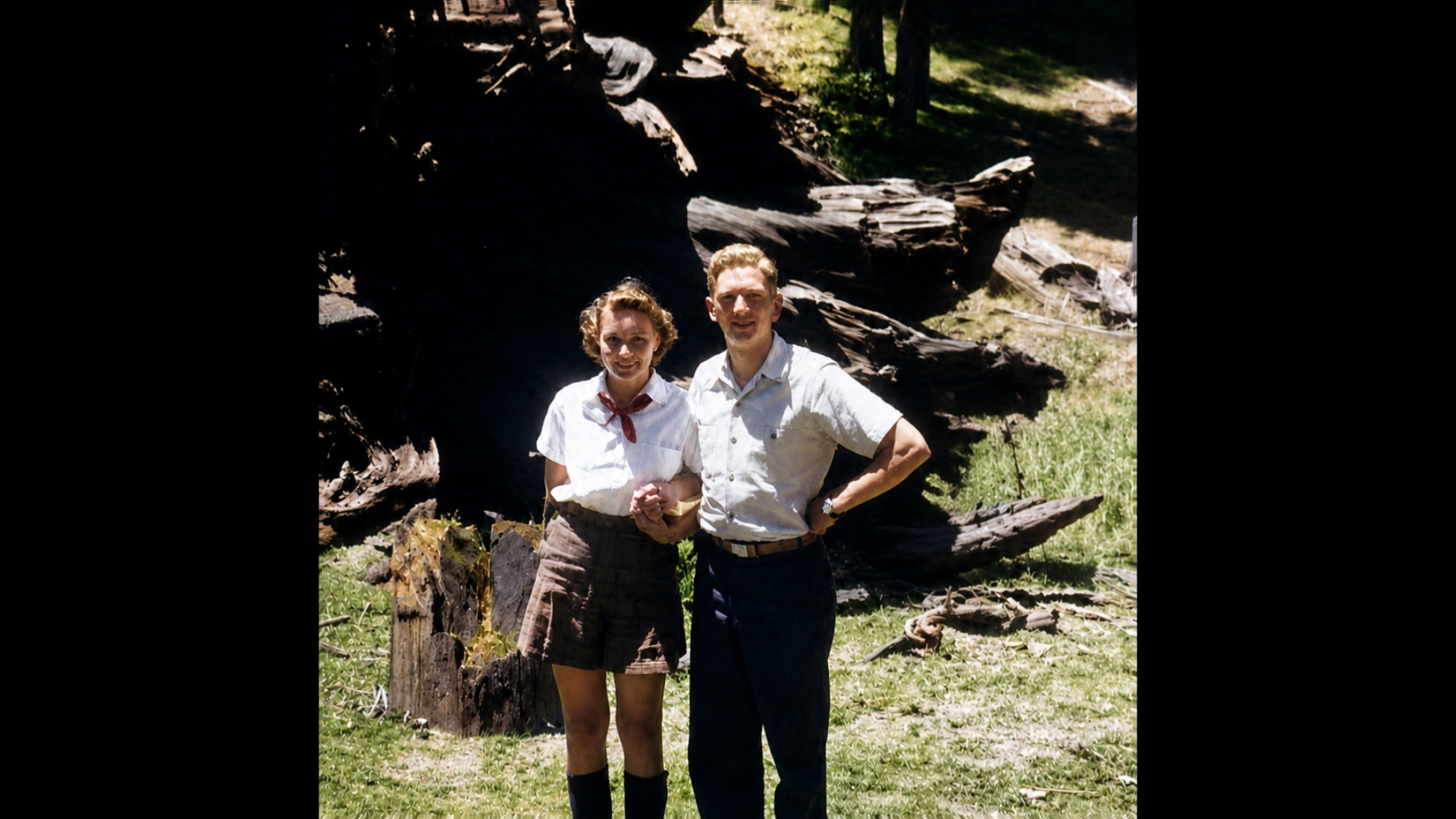
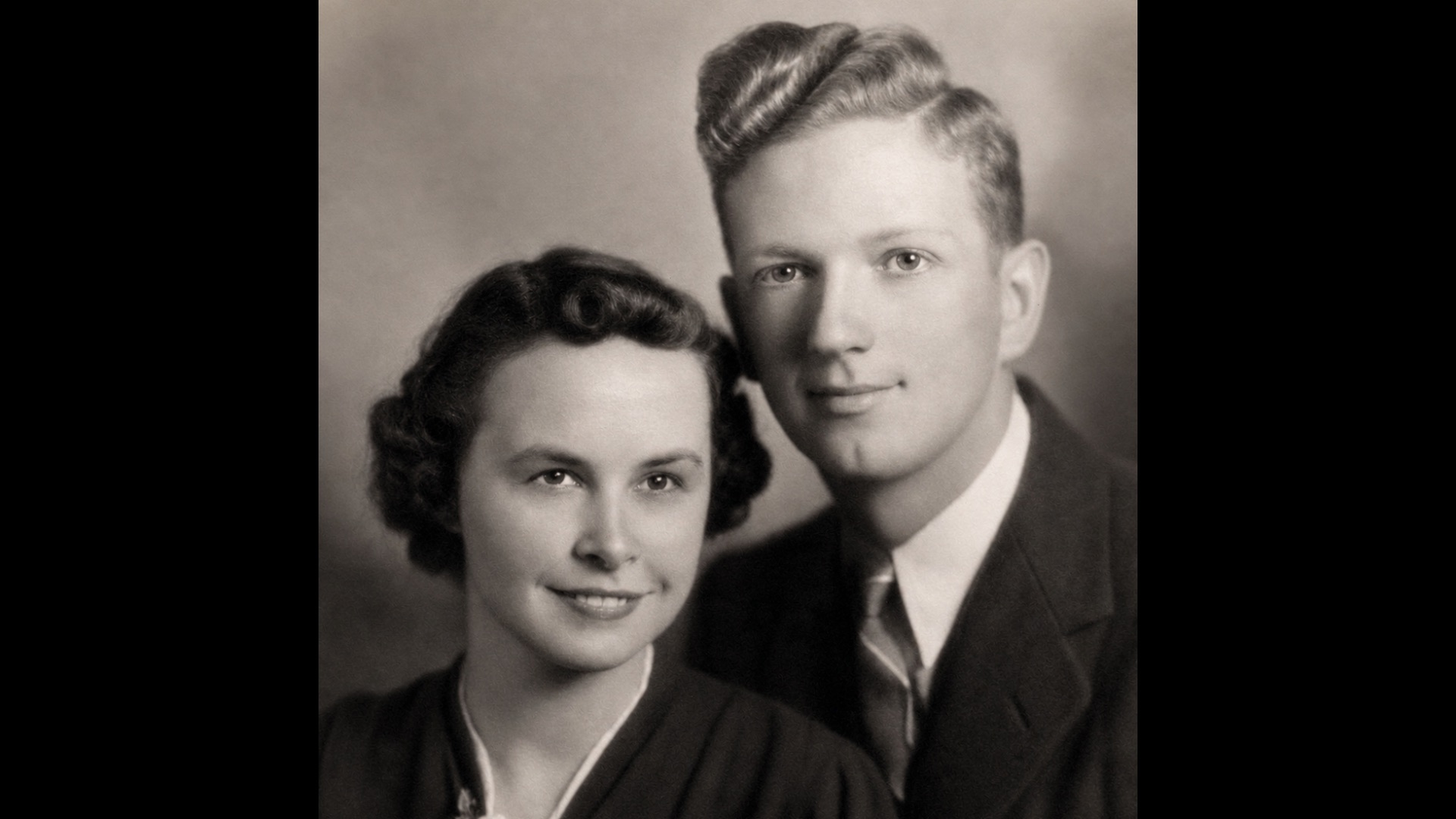
This morning, to start off our time together, with Mother’s Day in mind, I want to share a great Naegeli family story with you about my mother-in-law, Eleanor. At the age of 23, alone, with one or two suitcases in hand, she boarded a bus in rural Minnesota. She rode across the country to Fresno, California in order to marry her college sweetheart, Harold Naegeli. The year was 1937 and Harold was now an army officer giving logistical support to a Civilian Conservation Corps project to build Sequoia National Park. Harold picked her up at the bus station in Fresno, drove 90 minutes or so deep into the Sierra Nevada to the CCC camp.
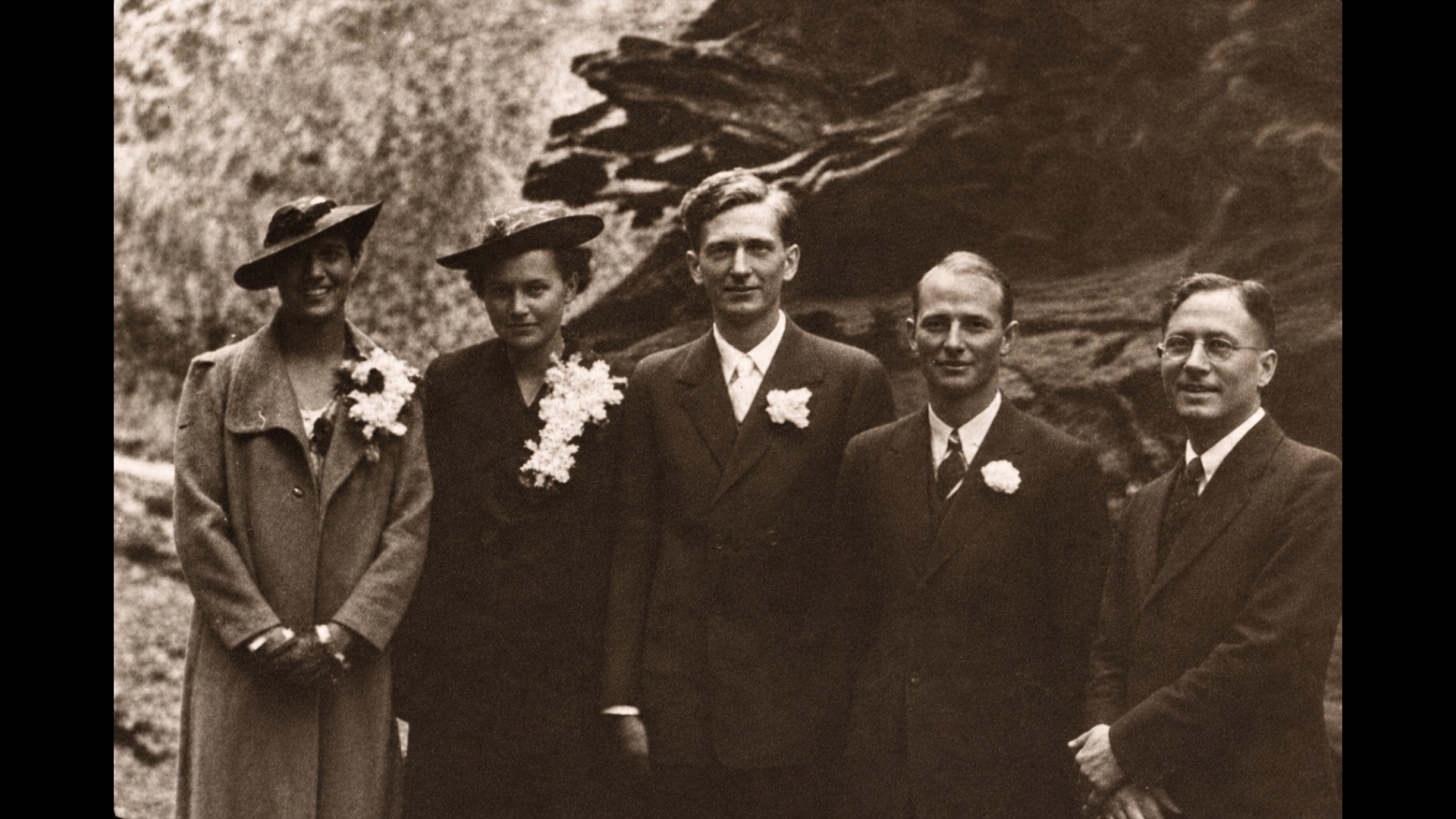
There, under the giant sequoias, they were married by the base chaplain on September 3, 1937. The chaplain’s there on the far right. And I think those were just folks in the camp who witnessed their marriage. And then they lived in a tent cabin for the first six months. I just think, what a great beginning to a 63-year-long marriage. I marvel every time I think about it.
Eleanor Stenglin Naegeli left her family in Minnesota to make a home in California. Her choice demonstrated courage, resilience, lifelong commitment and loyalty. And what she gained was a home, the place where she belonged.
Lest you think my mother-in-law’s story is a frivolous indulgence, I tell it today because of our sermon context. This is the parallel to Ruth and her journey. A parallel that’s unmistakable. Ruth made a similar cross-country journey from Moab to Bethlehem, accompanying her elderly widowed mother-in-law, Naomi, back to her hometown in Bethlehem.
But I get ahead of myself. So let’s set this up in the context of our ONE story idea we’re pursuing all year. As we proceed with our one year in the one book, the Bible, we recognize the one story of God progressing through its pages. We’ve been highlighting the links that carry this one story forward to Jesus Christ.
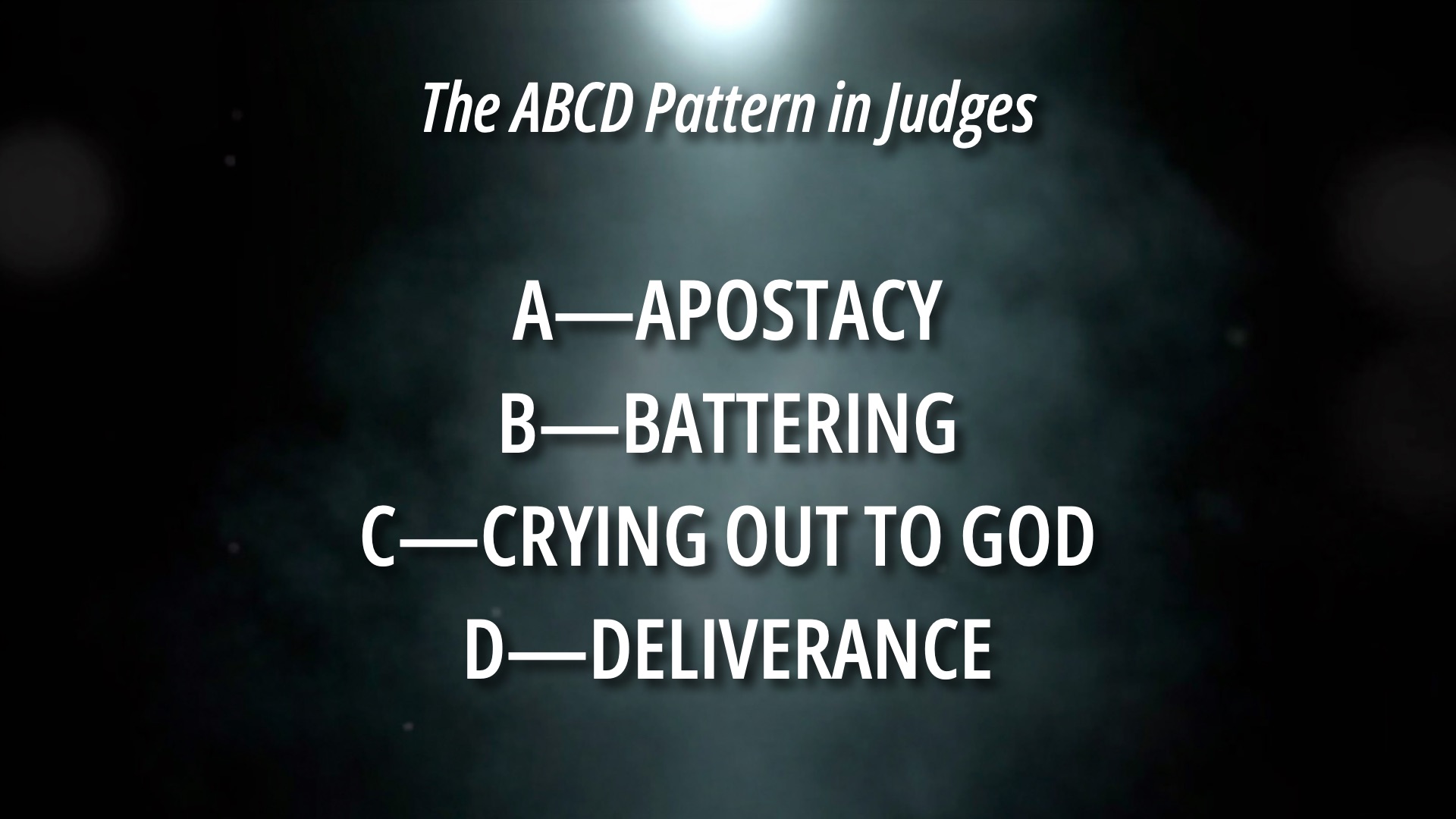
Last week, Pastor Bart had the unfortunate privilege of covering for us the horrible Book of Judges and pondered many of the questions it raises for us. It’s full of violence. Political chaos ensues and spiritual unfaithfulness grows. A constant pattern recycles through the Book of Judges. So one way to remember it, this is how I remember it, is using the ABCD pattern. We’ve got that there. Yeah, okay. It starts with A: Apostasy. The people fall away from the faith, after which the people of Israel are battered in battle, war, political intrigue at the hands of the Canaanites. And then C: They cry out to the Lord and finally D: they are delivered by God, usually in the person of a judge, who will bring some order out of the chaos in each of these episodes. These episodes repeat through the book and we see a general degradation of the circumstances and the spiritual condition of the people.
By the end of the Book of Judges, the observation is made that there was no king in Israel. The people did what was right in their own eyes.
Against the backdrop of this ugly account, the sweet little Book of Ruth appears in our biblical canon. We have to wonder why it’s even there. Just four chapters long, it is a tender love story featuring resilient characters, rich wordplay which we can’t fully appreciate reading it in English. It includes a sophisticated structure, humor, plot twists and a happy ending. Jane Austen herself could not have written a better plot.
Two widowed women without men to offer financial and domestic security. So here’s how the story of Ruth goes. Life was so bad in Bethlehem at the time of the Judges that a man named Elimelech took his wife Naomi and their two sons and moved to the greener pastures of Moab. Now, Moab was a place considered enemy territory to the Israelites, so that just shows you how desperate they were. It’s about 80 miles southeast of Bethlehem, but on the other side of the Dead Sea.
After a short time, Elimelech died. Without fatherly guidance, the two displaced sons of Israel married local Moabite women. About 10 years after that, the two sons died, leaving their wives Orpah and Ruth, childless.
Now, just parenthetically a fun fact here, this is the biblical Orpah, after whom Oprah Winfrey is named. Orpah appears on her birth certificate, but everybody mispronounced it and Oprah stuck. Important to know this, okay.
It is crucial to the story, though, that we appreciate the dire circumstances these events put on the three women, all of whom are now widows. Naomi has no husband and no sons to carry on the family line, which leaves her without status, no visible means of support, and as a foreigner in Moab, she doesn’t even have that Jewish sensibility about taking care of widows and orphans. Her life has become an empty shell, and she laments her losses bitterly. That appears also in the Book of Ruth. Her only wish was to get back home to Bethlehem where she belonged, where her people of the tribe of Ephraim might possibly give her minimal support. There, at least she has a past, even though she has little future.
So she urges her Moabite daughters-in-law, Orpah and Ruth, to stay in Moab and basically start over and marry Moabite men. Ruth and Orpah are still fairly young, and childbearing was not out of the question. And Orpah decided to go ahead and return to Moab, realizing it was a bleak future for her if she were to go to Bethlehem.
But Ruth reacted very differently. Perhaps you have been at a moment like this in your life where you know you’re at a decision point that will redefine you, redefine who you are and whose you are. This was Ruth’s moment of truth. So when she asked herself the question, who am I? Where do I belong? And with whom, she no longer considered Moab, that place, nor the Moabites, her people. Home was where Naomi was.
Ruth made her decision about her future, ordered not by her cultural identity, but by her commitment to family. She insisted on staying with the old woman and not only accompanying her on the journey back to Bethlehem, but staying with her for life. So she said, “Naomi, I’m going where you’re going. Don’t urge me to leave you or to turn back from you. Where you go, I will go, and where you stay, I will stay. Your people will be my people and your God, my God.”
A very significant commitment there, too, a religious commitment. “Where you die, I will die, and there I will be buried.” It’s very possible the last time you heard that verse recited was at a wedding. But here it is in the context of a daughter-in-law seeing her duty and following through.
On the bedrock of Ruth’s temperament, at least, if not her faith, which we don’t know that much about. On that bedrock was a sacrificial loyalty to the woman no one else would take responsibility for. Her choices were countercultural, courageous and committed.
And so off they went to Bethlehem. Bethlehem translates from the Hebrew, the land of bread. And it was Naomi’s home. Once there, Naomi realized her late husband did have a distant relative in Bethlehem by the name of Boaz. And at the same time, Ruth is facing the fact, the very real reality that they needed food to eat. So she offered to go out into a local barley field and glean, that is to follow behind the reapers and pick up stalks of grain that fell by the side of the field.
And in the tradition of the best Hallmark movie, Ruth discovers that that field she picked just happens to be owned by Boaz himself, and just at the right time, too. As he shows up that day to inspect the reaping operation, he inquires of his laborers who this foreign woman might be and is informed of Ruth’s journey, her hardships, and loyalty to her mother-in-law.
The story unfolds to reveal what Boaz did and how it helped the family. Boaz invited Ruth to stay and glean on his field, where he knew she would be safe from verbal and physical abuse. As a solo Moabite woman, he invited her to eat at the table with him, thereby adopting her into his clan. This is huge. He instructed his reapers to cast off plenty of grain for her to gather, so she carried home more than 20 pounds of barley that first day. He was an abundant provider.
And through a little scheming on Naomi’s part and Ruth’s integrity, the story reaches its culmination. With Boaz now working the system so he can marry Ruth, it turns out there is a slightly closer relative who has right of first refusal to redeem Naomi’s debt. So Boaz calls a town meeting to address the issue at hand. And here we pick up the story in Ruth, chapter four.
Ruth 4:3–12 (NIV)
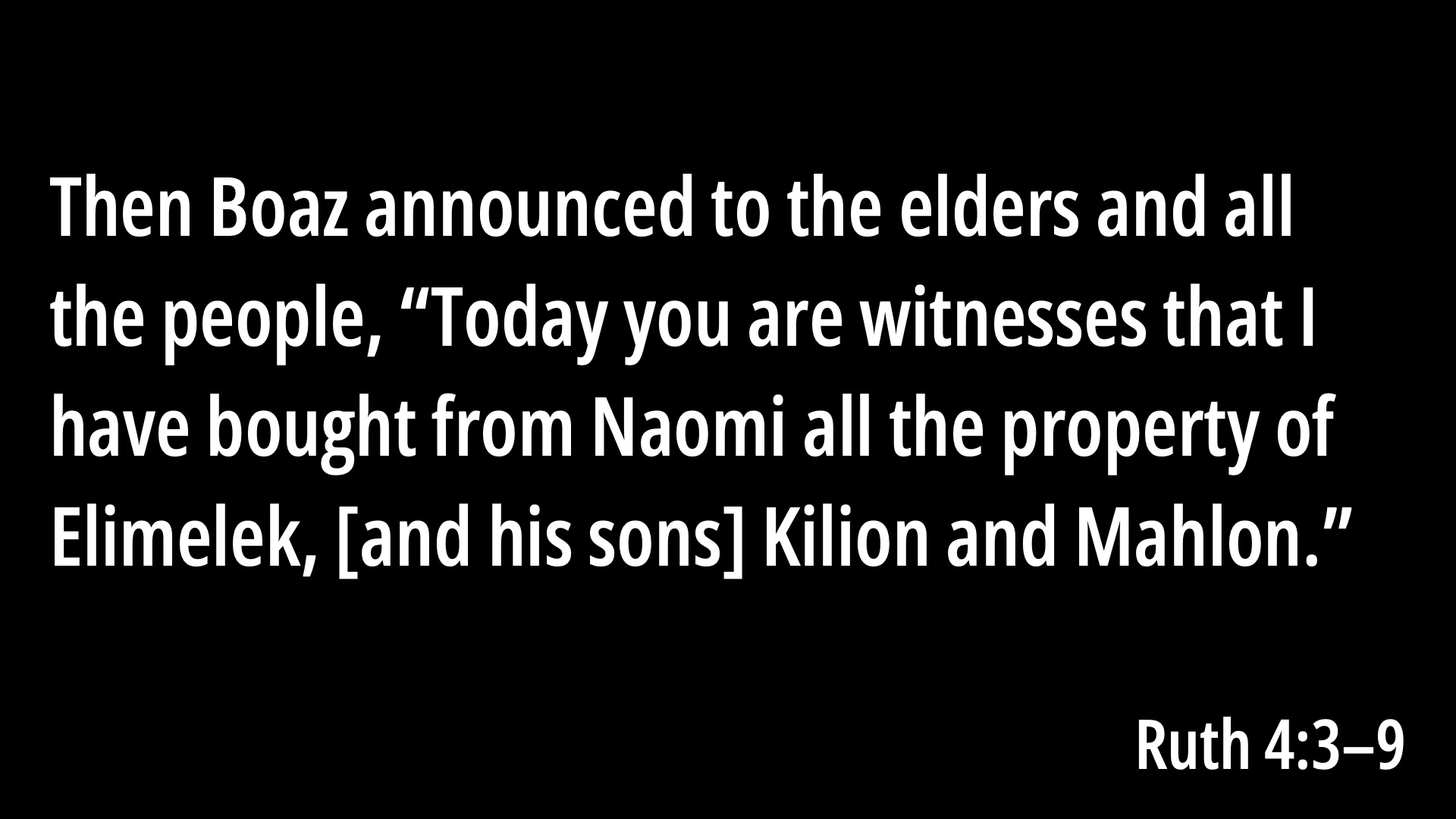
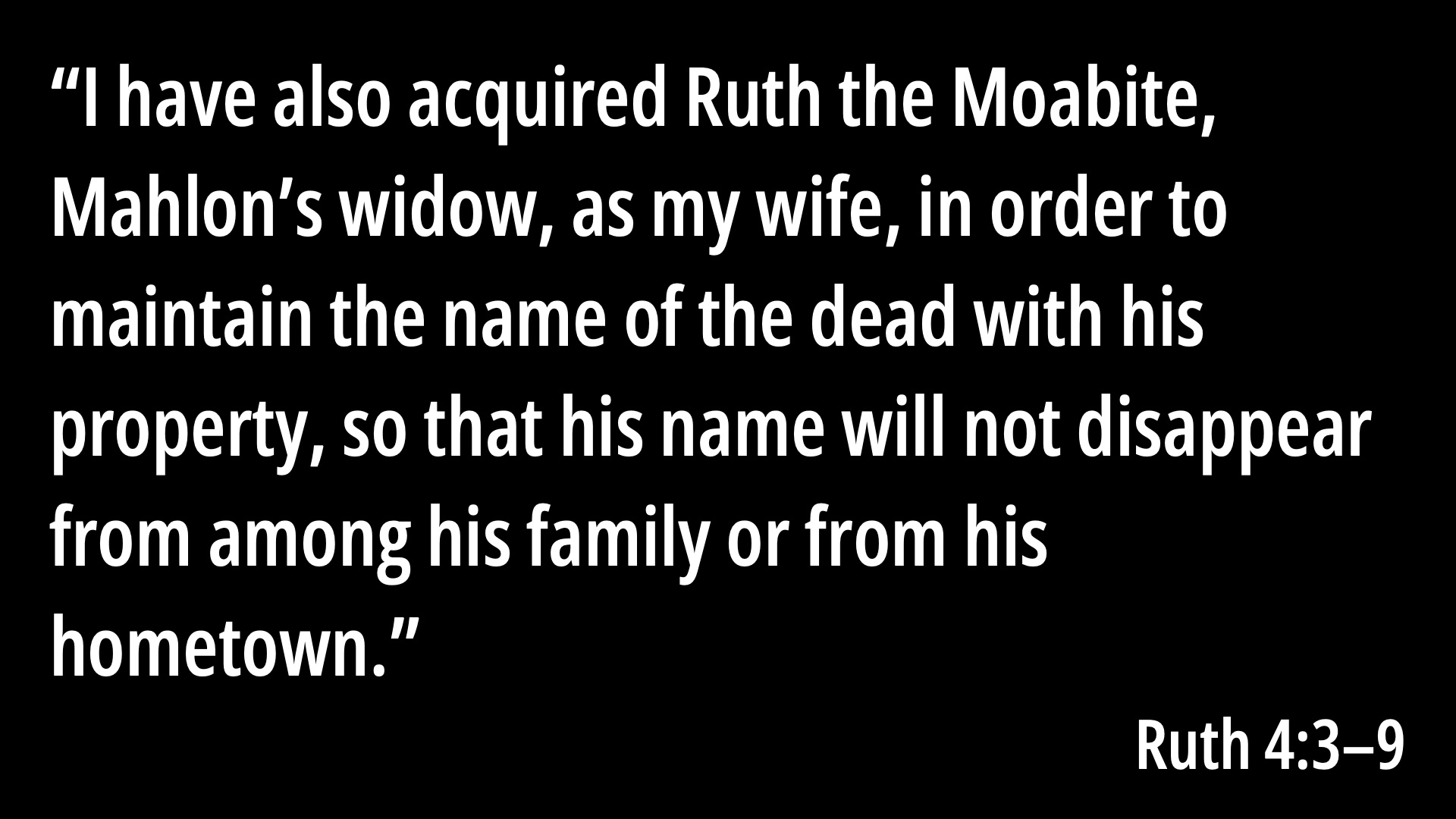
3 Then Boaz said to the guardian-redeemer, “Naomi, who has come back from Moab, is selling the piece of land that belonged to our relative Elimelech. 4 I thought I should bring this matter to your attention and suggest that you buy it in the presence of the elders of my people. If you will redeem it, do so. But if you will not, tell me, so I will know. For no one has the right to do it except you, and I am next in line.” “I will redeem it,” he said. 5 Then Boaz said, “On the day you buy the land from Naomi, you also acquire Ruth the Moabite, the dead man’s widow, in order to maintain the name of the dead with his property.” 6 At this, the guardian-redeemer said, “Then I cannot redeem it because I might endanger my own estate. You redeem it yourself. I cannot do it.” 8 So Boaz announced to the elders and all the people, “Today you are witnesses that I have bought from Naomi all the property of Elimelech and his sons, Kilion and Mahlon. 9 I have also acquired Ruth, the Moabite, Mahlon’s widow, as my wife, in order to maintain the name of the dead with his property, so that his name will not disappear from among his family or from his hometown. Today you are witnesses!”
Yay, Boaz. The story has a happy ending. Everyone wins.
And so we take a look at this from the perspective of the grand narration of the Bible. And these are the ideas that are introduced by the book of Ruth. First of all, that home where one belongs is not only where the heart is, but where one is willing to risk comfort for the sake of commitment to a higher calling. Loving kindness toward neighbor is noticed and rewarded. Thirdly, God continues to demonstrate his faithfulness and redeeming nature that takes in strangers, provides for, protects and saves them from certain ruin and secures their future.
Now this is beginning to sound a lot like the Gospel of Jesus Christ. Jesus has been seeking and saving the lost for generations.
So we finally arrive to answer the question that’s on our minds. Why is this little sweet book in the Bible? It is so much more than a Hallmark movie diversion from the horrors of the situation in Israel at the time. It serves by its placement in the biblical canon and by its tenderness as a beacon of hope in a blinding storm of events.
First of all, it teaches us that despite how bad life looks, God is at work. He is faithfully working out a plan in and through ordinary circumstances and seemingly insignificant people. Now we too are those people. Life goes on. Complications arise or calamities fall, and sometimes we’re just blind to anything hopeful. Our life seems to stall and we don’t know where we belong. We can’t see the meaning in what we do, and we can’t deal with the losses we’ve experienced or we can’t get out of the hole we’ve dug looking for elusive reward.
But this we know from the story of Ruth. God is working a plan that will get us back to where we belong, walking in the footsteps of Adam and Eve. People have thought they could get there on their own by defining on their own terms what is good and acting as if they were God in this kind of darkness. Ruth’s risky and stubborn loyalty to Naomi and Boaz’s moral integrity and loving kindness to them both are bright lights. They give us hope that God’s plan for redemption can carry on even through Israel’s darkest hour.
The story of Ruth and Boaz also advances the mission of God unfolding in the Old Testament by highlighting one thread in the tapestry of Israel’s waywardness that is the story of the Book of Judges. We see God in the background, weaving redemption through the tribulations of Naomi’s life. God brings support for her husband’s lineage through the adoption of Ruth into the clan of Israel and through her, providing the family tree that extends all the way to her great-grandson who became King David, and ultimately to Jesus of Nazareth.
Boaz and Ruth’s names are enshrined in the genealogy that appears in the Gospel of Matthew. It is only in retrospect that we recognize how important Ruth and Boaz actually are.
And there’s even more good news for us on this side of the cross and resurrection of Jesus Christ. And that is that God is still weaving outsiders into the tapestry of God’s great plan. The Gospel is good news, good news available to everyone. So if you yourself are feeling too ordinary or too foreign or like a fish out of water just by being here this morning, if the Christian tribe is not your tribe yet, we want you to know that you are welcome in our midst. We’d love it if you were to seek adoption and weave into our fellowship around Jesus Christ, our Savior and Lord. You are not out of place. You may be right where God can touch you and adopt you quietly and unobtrusively, the way God works in human hearts.
If this is something you’d like to talk over with one of our staff members, you can come see me after the service or talk to one of the prayer ministers in the back of the church. Or maybe put that on the Connect card. We’d be happy to talk to you.
Now, for those of you who feel secure in the Christian family, we have an assignment. If God was on a mission in the Old Testament and Jesus was on a mission in the Gospels, and the Holy Spirit empowered the disciples for the mission we see in the Book of Acts, then we, the church, are continuing that same mission in and to the world. God uses ordinary, quiet people just like you and me to plant seeds of faith to give testimony to the reality and wisdom of God, to befriend those who feel displaced or spiritually restless. That is our job. We are all on the road toward a spiritual home, the land of bread, as it were. And our eternal hope rests on Jesus carrying us there.
May God bless to us his word. In the name of the Father, Son and Holy Spirit.