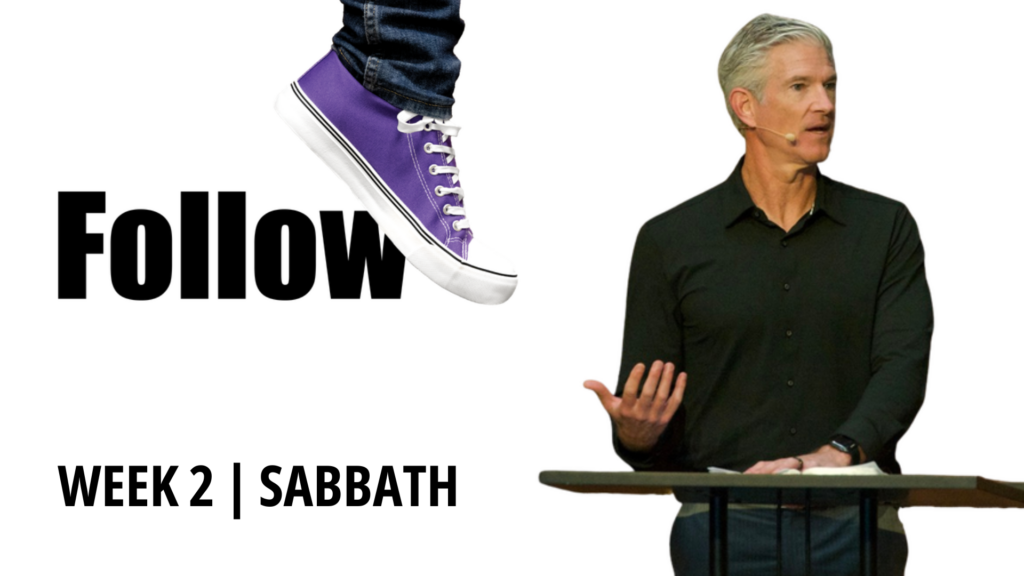
Bart Garrett:
Mark 2:23–28 (NIV)
One Sabbath Jesus was going through the grain fields, and as his disciples walked along, they began to pick some heads of grain. 24 The Pharisees said to him, “Look, why are they doing what is unlawful on the Sabbath?”
25 He answered, “Have you never read what David did when he and his companions were hungry and in need? 26 In the days of Abiathar the high priest, he entered the house of God and ate the consecrated bread, which is lawful for only priests to eat. And he also gave some to his companions.”
27 Then he said to them, “The Sabbath was made for man, not man for the Sabbath. 28 So the Son of Man is Lord even of the Sabbath.”
Mark 3:1–6 (NIV)
Another time Jesus went into the synagogue, and a man with a shriveled hand was there. 2 Some of them were looking for a reason to accuse Jesus, so they watched him closely to see if he would heal him on the Sabbath. 3 Jesus said to the man with the shriveled hand, “Stand up in front of everyone.”
4 Then Jesus asked them, “Which is lawful on the Sabbath: to do good or to do evil, to save life or to kill?” But they remained silent.
5 He looked around at them in anger and, deeply distressed at their stubborn hearts, said to the man, “Stretch out your hand.” He stretched it out, and his hand was completely restored. 6 Then the Pharisees went out and began to plot with the Herodians how they might kill Jesus.
Well, good morning, everyone. I join Devona in welcoming you. I’m Bart Garrett, the lead pastor here, if we haven’t met yet. And he’s back—if you were here Ash Wednesday, you saw Copper, who is still the bestest dog in the whole wide world, and this is still his best side. And I had a little rendition of a Copper story Ash Wednesday, and I’m going to give you, not the expanded version today, but I think this metaphor is so important for us.
I’ve discovered very recently that Copper enjoys picking up sticks, and he will carry those sticks for miles. So I consulted ChatGPT: Why do dogs carry sticks? I got anything from instinct to boredom to anxiety. So I asked Copper about this, and I felt like he was admitting both boredom and anxiety to me. He says, “Bart, two things. One, I’m bored. Your wife is right. You’re not much the conversationalist. Two, I’m anxious. I stay in a warm house. I sleep in a soft bed. Food magically appears in my bowl twice daily. I have a lot to worry about.”
So the question is, why do we pick up and carry the things that we pick up and carry? Or what are you carrying like Copper—sticks that you shouldn’t carry or you just don’t want to put down? And I said Wednesday, that might be a habit or a feeling. It could be two hours of doom scrolling or it could be panic about the future, which might be correlated. It can be an addictive substance or an addictive activity—pot or alcohol or pornography or gaming or gambling. It can be a small thing that is distracting you or it can be a really big thing that is derailing you. And you need, I need, we all need a reset, a reboot. And that’s part of what the Lenten season is all about.
This 40-day journey, as Devonna was talking about it, of following Jesus to the cross. Hence this theme: Follow. And this is a moment where we can put down some of the vices in our life and take up or pick up some of the virtues. And these virtues this season—and hopefully you, if you didn’t get one of these Ash Wednesday, I want to really encourage you to pick up one of these Follow journals today. I hope everybody in our church has one and makes use of it. But on page six and seven we’re looking at some of these virtues as priority. And so Wednesday night we looked at solitude, which is on the top of page 7. Today we look at Sabbath.
And I said Wednesday, and I say today: This is not mere self-help. You may need therapy, you certainly need accountability. But this involves following Jesus, who brings you into life so you don’t have to wallow around in death anymore. In this Follow journal, our definition for Sabbath reads this way: Sabbath is intentional pausing from work in order to rest, worship, and delight.
And we’re going to be telling the story of Jesus through the Book of Mark. It’s one of the four gospels. It’s the shortest gospel. It’s the first gospel written, and it is action-packed. We already have two stories on Sabbath right here in the first couple chapters. So I want to give you kind of four Sabbath principles that I want to unpack this morning. And they’re on the screen, you can follow along.
Principle number one: There is a Sabbath. Number two: Be blessed, not burdened by it. Number three: Be a blessing, not a burden in it. And number four: Draw near to God. Use Sabbath to draw near to God.
So principle number one: There is a Sabbath. In fact, in Scripture you’ll hear the word “Sabbath” show up 154 times. And think about this: Sabbath makes the list. And some of you know what I’m talking about—the 10, not suggestions or considerations, but commandments. Sabbath-keeping is actually on the same list as worshiping idols, committing murder, adultery, and stealing. Gulp. Yet commands in Scripture are not intended to bring us death, but to give us life.
So here’s a question for you this morning. And it’s unfair to ask you this question since you’re the ones that set your clocks forward or backward or whichever one we’re supposed to do. But the question is: Do you observe regular Sabbath in your life of any sort? And please know I ask that question with no guilt attached to it whatsoever. I am 100 percent in this to help you, not to harm you. I would never do what I do unless I did it because I wanted to see you flourish as a human being.
Which brings us to Principle 2. Principle 1: There is a Sabbath. Principle 2: Be blessed, not burdened by it. Observe Sabbath as a blessing—blessing, not a burden. Look at verse 23 again. The disciples of Jesus are picking up heads of grain, which was considered unlawful because it was a form of harvesting. So from this Sabbath principle of the Ten Commandments, derived in rabbinical tradition, are 39 categories of work that are prohibited. And one of those categories is harvesting or reaping. And a second of those categories is providing medical treatment on the Sabbath.
Now, there’s an exception made for life-threatening situations. But this man with the shriveled hand—not a life-threatening situation. So it will wait till Monday was sort of the way the rule of thumb worked. This accentuates burden, not blessing. Yet Jesus accentuates blessing, not burden. Look at verse 27. “Don’t you know that human beings are made for the Sabbath?” Oh, nope, that’s not what it says. “Don’t you know that the Sabbath is made for human beings?”
Think about it like this. Say you really need a car and a close relative comes to you and says, “Hey, I know you need a car. I have a gift for you. I want to give you our old 1992 Honda Prelude. It’s got 327,000 miles on it, but you can have it.” Now, would that be a blessing to you? No, it would be a burden. But what if that same relative came to you and said, “Hey, I know you really need a car and I’ve got enough saved up for this. I want you. I will buy you any car that you want, spare no expense. I’m going to pay the title, the registration, I’ll pay the taxes for it. All you got to do is once a week, take it for a spin, keep the engine humming.” Would that be a burden to you? Of course not. It would be a huge blessing. And that’s what Jesus is getting at as he alludes to the Ten Commandments: Remember the Sabbath by keeping them holy.
And when the commandments show up in Exodus, it says, “For in six days God worked, but on the seventh day, God rested.” In Deuteronomy, the other place in Scripture—Deuteronomy 5—where the Ten Commandments show up, there’s the same principle, but a different rationale. Remember the Sabbath and keep it holy. For six days God worked and rested. But also: “Did you not know that the Lord delivered you from slavery by his mighty, righteous right hand?”
So catch this: Rest. The gift of rest, the blessing of rest is both satisfaction and liberation. The blessing of Sabbath is twofold. The first blessing is you can move from discontentedness to satisfaction. That’s what God is after in his rest. In Genesis 2, as God created, did God rest because he was tired? Was he throwing the rings around Saturn and his wrist started hurting? He’s like, “Man, I really need to rest here.” No, he rested because he was utterly satisfied. He said, “This is good.” God’s satisfied, gratified. Rest is the model for us to regularly satisfy, cease from, and enjoy the work of our hands.
Rabbi Elijah of Vilna put it this way. He wrote, “God stopped to show us that what we create becomes meaningful to us only once we stop creating it and start to think about why we did so. We have to remember to stop because we have to stop to remember.” So the question is: Is there satisfaction and gratification in your life, or are they at a deficit? If they are, you may need more Sabbath.
But the blessing of Sabbath is also a blessing that moves us from bondage to liberation. Again, this is Deuteronomy chapter 5: that we are free from who we were. See, slaves have no choice but to work 24/7/365. But we are rescued from an unrelenting boss with his mighty hand. Anyone who cannot rest from work or can’t get away from their work is enslaved. Maybe you are enslaved to the need for success, or to your parents’ acceptance or approval, or to consumptive materialism, or to pursuing leisure, or to building a retirement nest egg that will never simply be big enough.
And it’s unkind to not say this this morning: It’s not just you. There are collective realities to this as well. Exploitative employers, unrelenting bosses. Twenty-five years ago, there was a famous experiment where some lab rats in the laboratory were put on amphetamines, and it takes a really high dose to kill one rat. But if you put a group of rats together, the lethal dosage is 20 times smaller because they hype one another up. And this is what was crazy: You put one rat in that group of 25 rats with no amphetamines, and it would still hype itself up to death in 10 minutes.
So is Sabbath countercultural? Yes, big time. We are invited into a slave’s revolt, a revolution of rest, a satisfying, liberating rest that brings us joy. It’s not about rule-keeping, but life-giving. Now I have a lot of practical suggestions for this, but we try to preach short sermons here because your attention span is like my attention span. So we have another podcast, the Preacher P.S., which is the second podcast where we unpack more of the sermon. I’m going to give you some practical suggestions there, so find it wherever you subscribe to your podcasts.
But let me say here: God never gives you more to do in a week than you can do. So if you have more to do in a week than you can do, it isn’t God who’s giving it to you. It’s the stuff on your list that you gave yourself, or a boss gave you, or a friend gave you, or a family member gave you. And I say that not to make you guilty. Sabbath is a gift, but you have to open it. Sabbath is not a burden, but it’s a blessing.
Which brings me to Principle 3. So be a blessing, not a burden. Verse 3: Jesus says to the man with the shriveled hand, “Stand up in front of everyone.” Verse 4: “Then Jesus asked them, ‘Which is lawful on the Sabbath: to do good or to do evil, to save life or to kill?’ But they remained silent. He looked around at them in anger, deeply distressed at their stubborn hearts, and he says to the man, ‘Stretch out your hand.’ He stretched it out and his hand was completely restored.”
Now, in our tradition—Reformed Presbyterian tradition—we have these confessions that say the works on the Sabbath are works of piety, necessity, and mercy. And so I don’t want to bore you with the history of Sabbath debate, but we have a second podcast, the Preacher P.S., so I’m going to talk about that a little bit today as well, if you’re interested. But suffice it to say here: To be a blessing, not a burden to another person is to do good, not evil in their life, is to heal, not harm them. It’s to show mercy to them, to serve other people—and not just in an individual service, it’s also a collective responsibility.
In other words, you cannot be the exploitative employer. You cannot be the unrelenting boss. We have a faith and work cohort that we launched this year, and it’s been so delightful. One of my favorite things on Monday nights—and Tommy and I are participating with this group—and I’m learning so many things about how they show up in their life’s work. And I’ve noticed that healthy leadership has a tremendous impact on health and vitality in the workplace. One example: If you’re a boss, and now that we have technology everywhere, there are all these expectations on technology and on our work. We can work anywhere at any time. So we work everywhere all the time. You as a boss need to help your employees not feel that grind.
Principle number four: Lastly, Sabbath is a blessing, not a burden, so you can be a blessing, not a burden. But also, it’s to draw near to God. It’s to draw near to God. Verse 6: “Then the Pharisees went out and they began to plot with the Herodians on how they might kill Jesus.” Now that’s drastic. Can we just name it? That’s really drastic. What is going on here?
Well, put on your thinking cap for our last few moments. I want to do some deep theology. All right, you ready for it? Here it goes. The people of God were given symbols by God: Torah, the commandments, the land, the nation itself, dietary customs, Sabbath. These are all symbols. And the question is: What do symbols do? Well, symbols depict what people believe. They bring the affections of the heart into visibility. So if a picture says a thousand words, a symbol says 10,000 words. The American flag would be an example. So symbols also call people into action. They inflame passion. They also demarcate people. They’re badges of distinction. They become identity markers, boundary lines.
So the question is: What did Jewish symbols do for the Israelites during the Roman occupation? Answer: They staved off Hellenization. They allowed Jewish people to remain Jewish, not to become Greek. Symbols ordered their life and protected the people of God from this onslaught of cultural co-opting. So here we go. What did Jewish people make of Jesus’ use of the Jewish symbols? Defamation. They thought Jesus was defaming them. Only a traitor would do something like this. But what did Jesus make of his use of Jewish symbols? Answer: Fulfillment. Jesus offered a corrective. He said to these religious leaders, in the healing of this man, “Not only are you making the blessing of the Sabbath a burden, but you are also making it a barrier. Don’t you remember your father Abraham in Genesis 12? He was blessed to be a blessing. And you’re using that blessing as a barricade to push other people out.”
He was undermining the power of the religious leaders, and they plotted to kill him. But he was not only treacherous in their eyes, he was also blasphemous. In one of the stories in the Gospel of John, he said, “Before Abraham was, I am.” He was claiming divinity. How do we know? Because they pick up stones to stone him. And here in this first story, he’s saying, in this story of David in the temple, “I am justifying David’s actions because I am King David’s king. I am King David’s temple.” And they are saying to him, “Who do you think you are? God?” Yes.
Principle four: Sabbath is an invitation to draw near to Jesus, to draw near to God. Sabbath is made for human beings. And by the way, Jesus says, “I am the Lord of the Sabbath.” So the religious leaders were using Sabbath to draw near to their own self-righteousness and their practices of ethnic heritage via excluding others. Maybe that’s not you this morning. For most of us, maybe if we ignore and neglect Sabbath, then we might be using it to draw near to our work or to our leisure. But Jesus invites us to use it to draw near to God.
So as we conclude, there’s one other teaching on Sabbath from Scripture that I want to unpack. And it’s from this letter to the Hebrews, the end of our New Testament. Hebrews chapter 4: Sabbath is talked about as this deep and eternal rest. It’s inner soul rest connected to this will-last-forever rest. And what the author of Hebrews is unpacking here is that this rest from the work of justifying yourself before others and before God is grace. We overwork to justify ourselves. This deep rest of grace is accepting that all of this is Jesus’ work on your behalf. It’s not self-help. It’s the admission that I cannot do life on my own as my own god, and I need to rest in Christ’s work on my behalf.
Hebrews chapter 4, verse 11: “So then let us make every effort to enter into that rest.” In other words, God has done all the work for you, so there is some work to do, some effort to make. What is that effort? To draw near to God. And what happens when we draw near to God? James, Jesus’ half-brother, says if we draw near to God, God will draw near to us.
So if I were to ask you the question “How are you doing?”—if you’re under 50 years old, this is a generalization—you may say, “I’m fine,” but if I press deeper, you may say, “I’m so busy I’m exhausted. If I only had one more day in the week and two more hours in the day.” And if I asked you the question, over 50 years old, “How are you doing?”—a generalization, yes—but you might say, “I’m bored,” or “I’m tired,” or “I feel old,” or “I am old.” And we might be busy or bored, yes, but we’re not merely busy or bored. Often we are restless. And restless people are rarely comfortable with who they are. They haven’t been satisfied or free from who they were. They haven’t been liberated. Do you see? Back to the twofold blessing of Sabbath: the joy of satisfaction and liberation. Be gratified and be free.
St. Augustine said in his Confessions that we have been made for God, and our hearts are restless until they find their rest in him. Draw near to God, and God will draw near to you.
So in conclusion, a story that illustrates this. Two weeks ago, I gathered in what we call the Summit. And this is a gathering—this was the 19th year of this gathering. Eight pastors, two professors. The 10 of us met in Chattanooga, Tennessee. Four days of sharing, praying, laughing, crying, bourbon, and barbecue. And when I was coming back, I had a connecting flight through Detroit. And my eldest daughter now lives in Detroit. She’s 23 years old. This is her first city post-college. And she was away from Detroit. And it just so happened she was flying back to Detroit on the very same day. And I was scheduled to take off at 4:45 p.m., and she was scheduled to land at 5:15 p.m. And it turns out that I’m going to be taking off from gate A28, and she’s going to be landing at gate A24. Thirty yards walk. So I have a three-and-a-half-hour layover. I’m scheming about what I can do to have my flight delayed. Mostly I’m feeling in my heart this ache because I’m going to be so incredibly close to my daughter, literally yards away, yet I won’t even be able to see her. I won’t be able to give her a hug. I won’t even be able to talk to her for five minutes.
Then she gets in early. She gets in at 4:40, but I’m already on the plane. One plane over, 30 yards away, and we’re fever texting back and forth. I’m planning the wave. I’m counting the windows from the row I’m on, like, “I’m on this row, I’m going to annoy two passengers. You’ll see my hand, you know, as you look at the gate, waving.” But we don’t push back from the gate. And the pilot says there’s a medical incident, that they must bring medical personnel to assess a passenger’s fitness for travel. So they come aboard. I ring the flight attendant. I say, “Hey, I have a really strange request, and I understand you might not be able to grant it, but my daughter lives here. I haven’t seen her in three months. I landed one gate away. She’s standing outside of our gate, the boarding door is open. Can I be escorted up the jetway and just have a 10-second hug with my daughter?”
And the flight attendant is probably in her mid-30s, and she says, “Oh, I miss my dad so much, and I love to make these kinds of things happen. I have to ask the gate agent, who may say no, but fingers crossed.” And at this point, the medical personnel exit our plane with the sick passenger, and the flight attendant comes back and she says, “It’s going to be a big no. I’m so sorry. I would have loved to make it work.”
So there are many ways I wanted to embellish this story. I wanted to describe this full sprint down the jetway, my daughter and I crying tears of joy as I pick her up and swing her around and we exchange “I love yous.” Instead, in this great big world, we were 30 yards away, and I missed her. See, in this great big world, one day each week the veil is a little thinner, and God is, so to speak, only 30 yards away. God draws a little bit nearer. And the practice of Sabbath is an invitation to a proximity to God that will bless you with the joy of satisfaction and liberation and bless others with goodness and healing. To be near to God, don’t miss him.
In the name of the Father, Son, and Spirit, we pray. Amen.