Faith Taylor:
Our scripture today is found in Isaiah 11, verses 1 through 10.
Isaiah 11:1–10 (NIV)
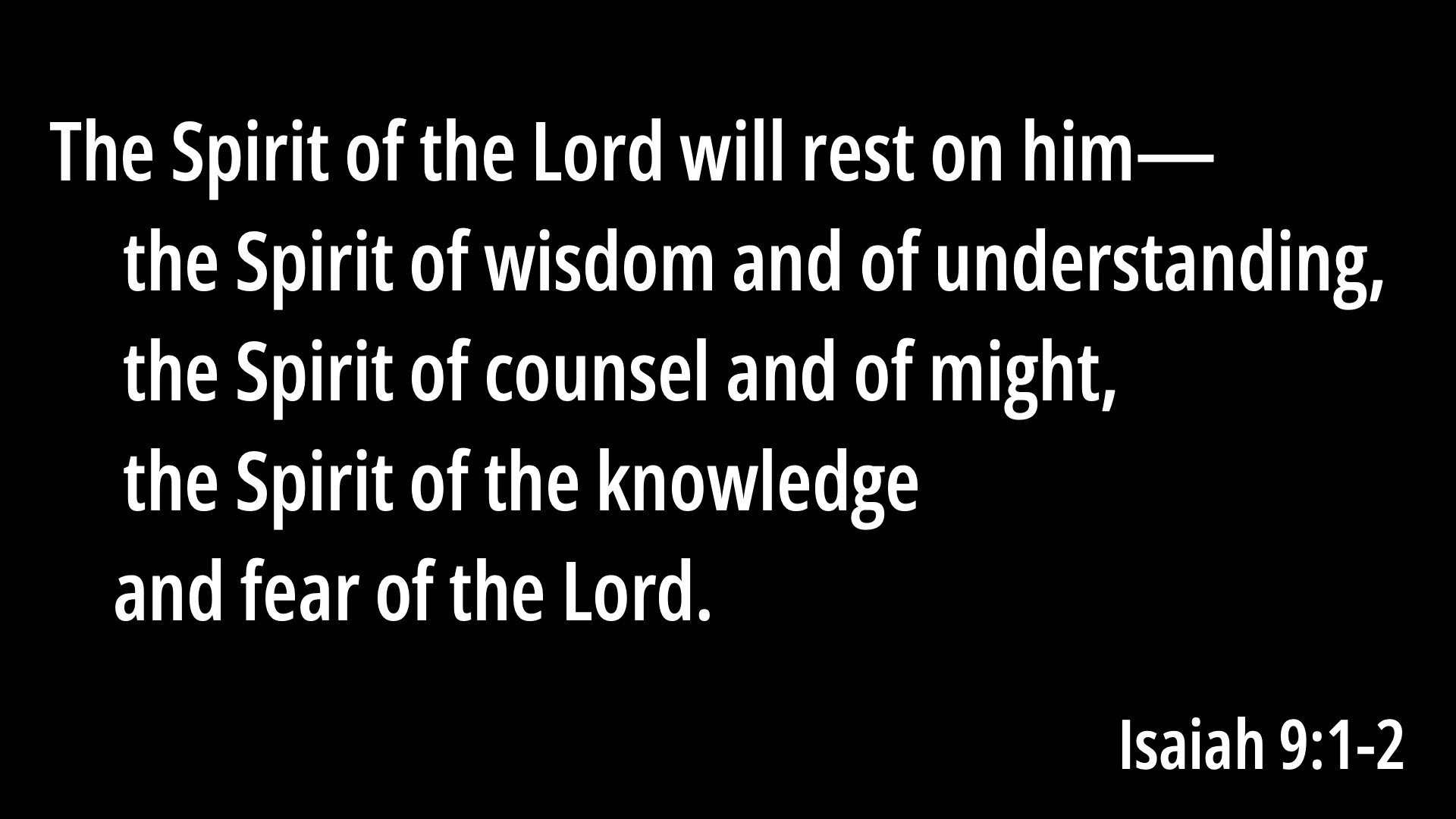
1 A shoot will come up from the stump of Jesse. From his roots a branch will bear fruit. 2 The Spirit of the Lord will rest on him, the Spirit of wisdom and of understanding, the Spirit of counsel and of might, the Spirit of the knowledge and fear of the Lord. 3 And he will delight in the fear of the Lord. He will not judge by what he sees with his eyes or decide by what he hears with his ears. 4 But with righteousness he will judge the needy. With justice he will give decisions for the poor of the earth. 5 He will strike the earth with the rod of his mouth. With the breath of his lips he will slay the wicked. 6 Righteousness will be his belt and faithfulness the sash around his waist. 7 The wolf will live with the lamb. The leopard will lie down with the goat. The calf and the lion and the yearling together, and a little child will lead them. 8 The cow will feed with the bear. Their young will lie down together. And the lion will eat straw like the ox. 9 The infant will play near the cobra’s den, and the young child will put its hand into the viper’s nest. 10 They will neither harm nor destroy on all my holy mountain. For the earth will be filled with the knowledge of the Lord. As the waters cover the sea. In that day the root of Jesse will stand as a banner for the peoples. The nations will rally to him, and his resting place will be glorious.
The grass withers and the flowers fall.
Bart Garrett:
Thank you, Faith. And if we haven’t had a chance to meet yet, I’m Bart Garrett, the lead pastor here. And I absolutely love first Sundays and baptisms and welcoming people like Matt and Jamie and their precious kids and elementary students. I love this too. But what I don’t love about first Sundays is I only get about 15 minutes. But all of God’s people said amen. So you get a short sermon this one year.
If you’re new with us, you saw by the title sequence, we’re being reminded about how this scripture tells one story. And we believe here. It’s a story of God’s never stopping, never giving up, unbreaking, always and forever love. And every first Sunday for our elementary students, just like you get a wonder truth in your classroom, we give you a wonder truth here so you can write it down. Take it to the Connect table after the service for a prize and I would invite you to take it into your life.
And so here is our wonder truth. Jesus is our rescuer because we believe we need to be rescued and because we believe we cannot rescue ourselves. Jesus is our rescuer. And this is how God’s never stopping, never giving up, unbreaking, always and forever love gets back into our world.
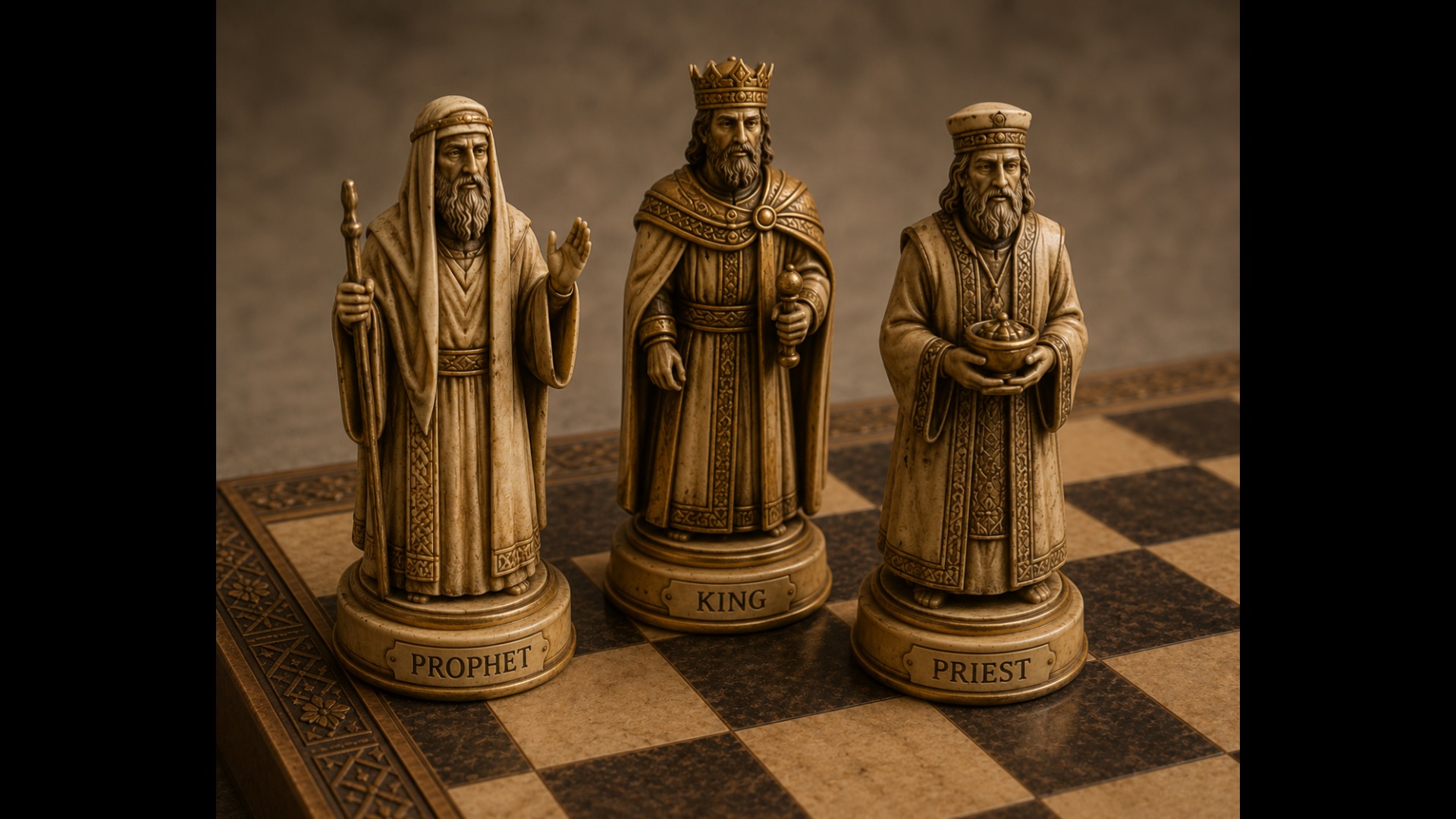
And today in our story in the Hebrew scriptures, we are shifting from the kings to the prophets. And there are thousands of things I would like to say by way of orientation, but I’m going to focus on one. You should know that all the nations of that day had gods, and they also had kings and prophets and priests. And so the nation was the supreme entity and the king was the supreme leader. So the prophets and the priests, they were conscripted to conscript the gods to do the bidding of the king and the nation.
But the Israelite nation was supposed to be different. God was the true king. The nation was subservient to God as their king. But the human kings of Israel often forgot about this arrangement. And so they tried to conscript prophets and priests to have God do their bidding, just like all the other nations.
But as we turn to the prophets like Isaiah, we experience in the poetry and the plots and the parables and the proclamations and other things that start with P, we experience God saying to both the people and the potentates, see, I can do the P’s all day. The kings, a call to repentance, turn back to the way of God, turn back to the plan of God.
And often these prophets paint a grand vision of reality. They name what once was the shalom of God. What is this dystopian disharmony? And what will one day be a revision of God’s shalom that’ll somehow be even better than before.
And so Isaiah, during the 8th century BC was advising the kings during very turbulent times. There was the rise of the Assyrian Empire. And he offered a warning against injustice and idolatry. And he offered the hope of renewal and future peace.
So as we think about this passage, I want you to hold two things in your mind for a couple minutes. The wonder truth, Jesus is Our Rescuer and the sermon title, the Best Stump Speech Ever. So imagine these two are tracks that run parallel to one another. And imagine there’s a streetcar on those tracks. A Streetcar Named Desire. Tennessee Williams would be so proud.
So let’s say you are waiting at the streetcar stop for that streetcar on those parallel tracks. Jesus is Our Rescuer. And the Best stump speech Ever. And the streetcar pulls up and the conductor says, can I take you to the end of the line? And you say, no sir, take me to the end of time.
So you go on a long ride on that streetcar, and it stops, and you step off, and what you find is very vast nothingness. You would describe it as black and dark, but there’s no space. You would say that time is standing still, but there’s no time. You would describe it as chillingly cold. Yet there’s no climate. There’s no there there. So the shivers of terror and the chills of loneliness and the shudders of meaninglessness that you’ve experienced at times on life’s journey are all but confirmed. You are nothing but the fleck on a speck on the freckle, on a mole on the wart found in some random wrinkle in the cosmos. Ew.
But imagine you’re waiting for that streetcar. By those parallel tracks. And the streetcar pulls up. And the conductor says, can I take you to the end of the line? And you say, no, sir. Take me to the end of time. So this time you take that long ride and you step off to clouds of fluff, to gates of pearl, to streets of gold, to cities of emerald. It’s foggy and cloudy and misty and frosty. It’s almost like you’re looking through a windshield on a cold day. So you rub your eyes only to discover that you have no hands and you have no eyes.
And about this time, a cherub floats by with chubby cheeks on both ends, strumming his harp. And you realize you are a disembodied soul. You say, is this heaven? Or is this that other place?
Or suppose this time you’re waiting by those parallel tracks. And the streetcar pulls up. And the conductor says, can I take you to the end of the line? And you say, no, sir. Take me to the end of time. And you step off to Isaiah’s poetry. Motion. The sky is brilliant blue. The clouds are ivory white. The grass is lush green. The flowers are vibrant orange and yellow and purple. And there is delight and joy and harmony. There’s this symphony of resonance. There’s equity. There’s flourishing.
And you start examining yourself. And your back is not sore and your knees don’t ache. And you look around socially and there are no awkward social moments. Because there’s shameless intimacy with one another. And bitterness doesn’t even exist. Contempt is an unfamiliar feeling.
So we hop off that streetcar of desire. I think we would all agree we do not desire the nothingness of the secular vision, where we must maintain the fiction that life somehow has a point. Nor do we want the emptiness of the popular Christian vision, where there’s nothing left to do but sport a halo and sprout some wings and strum a harp. But I think we’re compelled toward that third vision. Isaiah, with compelling authenticity, speaks to a broken people in a messed up world and invites them into these deep longings and these big dreams. The harmony that we all want.
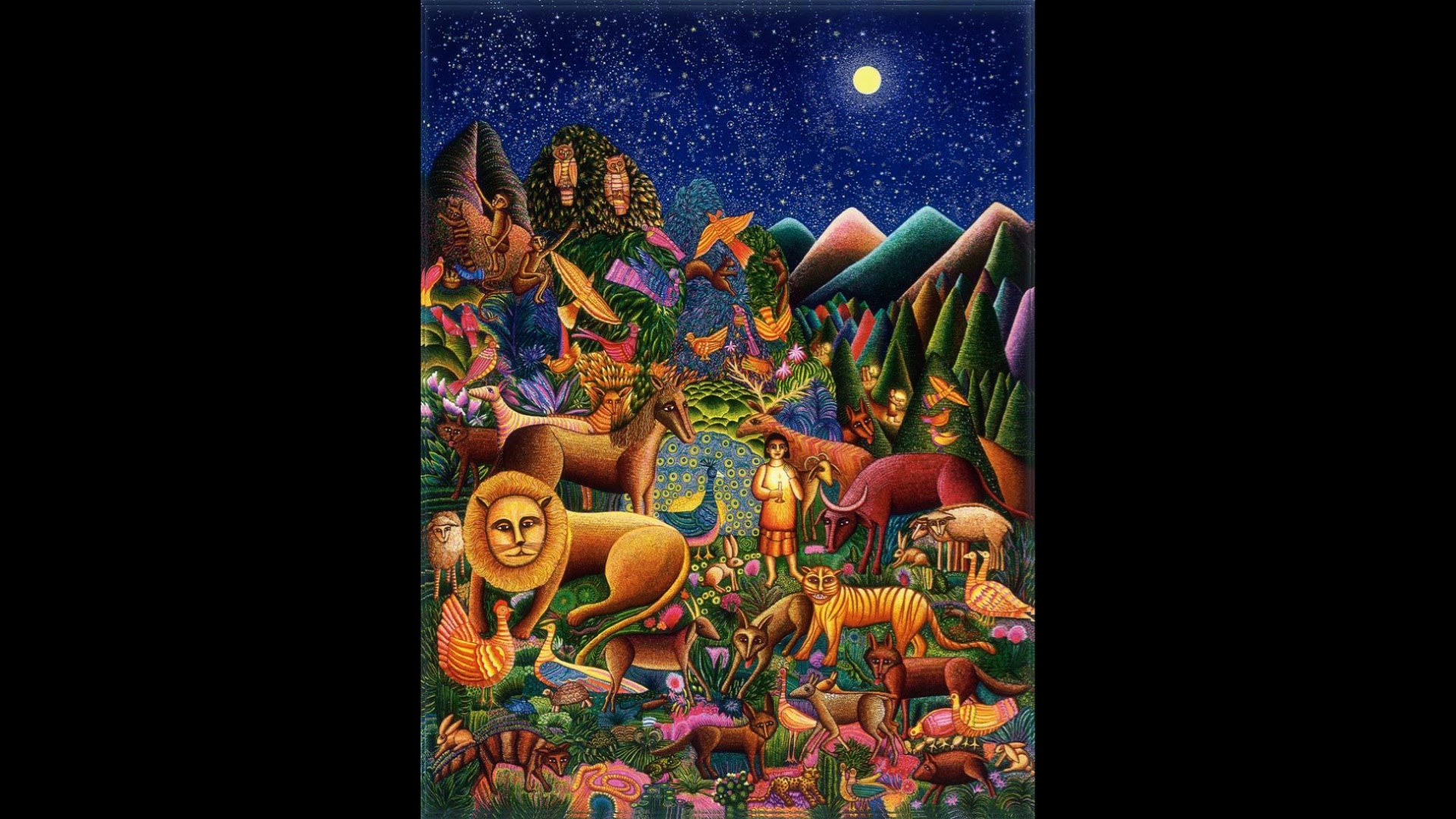
And as we begin with the end in mind, we feel it in all of his poetry. It’s like a merry go round of wonder. The wolf and the lamb, the leopard and the goat, the calf and the lion, the cow and the bear and the children are unharmed by it all.
And our prose could slow down the poetry a little bit. And we would see, ecologically speaking, that there’s no carnage. Sociologically, there’s no strife. There’s no striation or class. Politically, there are no politicians, only public service. Hallelujah. Economically, no one is in need. This is not a system of buying and selling, but of giving and receiving. Physiologically, there’s no malignancy. Psychologically, there’s no disorder. This is God’s peace, God’s shalom. The weaving together of God and humanity and creation and equity and fulfillment and delight.
But our desires and our longings intensify every single day. When we are met with the deep disharmony and the injustice that’s present in our world. We experience this instability in dozens of ways. Here are just two. One, our own psychological instability. We live in fear that either we’re going to make it or we won’t. That we are a fraud or a fake and the only way we cope is constructing a flimsy facade to show the rest of the world.
Or there’s sociological instability. Look no further than the middle school cafeteria. You sit at tables that can somehow shape the status you have for the rest of your life. Middle schoolers in this room. No wonder life can feel so full of pressure. Parents of middle schoolers in this room. No wonder life can feel so full of pressure writ large.
We see this in our nation with the saber rattling and the threat of war and the actual war. In our cities with poverty and classism and racism still so pervasive. In our neighborhoods where gossip and slander and infidelity abound. In our own houses and apartments where the walls are laced with deceit and rage and bitterness. Even in our churches where we’re supposed to be the R and D wing of heaven. Yet there can be power plays and deceit.
So how do we get to the world we have to the world that we want? In our youth, perhaps in naivete, we can assume wishful thinking. Or political activism alone will get us there, will usher in this final state of peace. But we know that it won’t. With experience as our teacher, we notice our proclivities to stretching the truth, to slander, even to slavery. We know deep down that there can be no peace without justice. And there can be no justice without judgment. And there can be no judgment without a judge.
So who is this judge? Well, we see in verse 3 and 4 that this is one who will not judge by what he sees with his eyes or decide by what he hears with his ears. But with righteousness, he will judge the needy. With justice, he will give decisions for the poor of the earth.
So we see this judge steps into inequitable, unjust situations, calls them out for what they are, evil and wrong, renders a verdict, bears a judgment that is just and true and good. That’s actually what the word in Scripture, righteousness means. He’s not swayed by what he sees or hears. He’s not bribed by a wrongdoer. He’s not coaxed by some slick attorney. He’s not driven by every whim and wish of our culture. But he’s compelled by a decision to bless the poor of the earth.
And in scripture, you should know, we see this in the Psalms. When justice arrives, the birds sing, even the trees clap their hands. Isaiah 11 actually reads like a great sigh of relief.
So I want to wrap up with our two streetcar tracks. Remember them? The best stump speech ever. And Jesus is our rescuer. Now, why would I call this teaching? The best stump speech ever. Some of you caught it. Look again at verse one. A shoot will come up from the stump of Jesse. From his roots a branch will bear fruit. So how does God plan to bring peace to the whole world? Through a stump. What? Through the stump of Jesse. Oh. What?
Let me ask you a question. Who is Augustine? Washington? Does anyone know? Who is Thomas Lincoln? Does anyone know? These are the fathers of the first and 16th presidents, George and Abraham. Maybe the best presidents we’ve had. My kids, when they were growing up, we had a place mat with all the presidents on it so they could learn the presidents. And we. What if for the 1st and 16th, you look at the titles and it just said the stump of Augustine or the stump of Thomas? It’d be like wiping George and Abraham off the place mat.
Well, Jesse was King David’s dad, the greatest king of Israel. But to be called the son of Jesse, this was a term of derision. It was used by King David’s enemies to mock his humble origins. What is more, the stump is cut down, which means the family line, the family tree is literally cut down. The grandest religious and political moment for the people of God. The reign of King David, all of its grandeur, all of its majesty, all of its power, cut down. Why? Because the instability, the disharmony, the injustice had become so severe that these fruits of unpeace had to be done away with. The whole tree had to be cut down.
But wait, what is Isaiah’s hope? Well, this is what we see too, in verse one. This little shoot from the stump of Jesse, a sprig new life would be brought forward from a dead thing. And whatever you believe about God, and we have a lot of people in our church that are exploring faith, trying to figure out where God fits in their life. Whatever you believe about God, most of us would say that God’s domain is bringing dead things to life. It’s just what God does now. We try to do it.
This is a passage often preached at Christmas time. So if it were Christmas, I talk about how we go out into the woods, we cut down a living tree, we kill it so we can bring it into our house and pretend that it’s alive again, dress it all up. But if we’re honest, we do this with our life as well. We know where we’ve been, we know what we’ve done, we know what we say. And everything about life is if I can just erase it, if I can just get a do over, if I can just get a fresh start. We cope with life, but we can’t bring new life out of dead things. That’s what God does.
And we see this in verse 2. The spirit of the Lord will rest on this judge. The spirit of wisdom and of understanding, the spirit of counsel and of might, the spirit of the knowledge and fear of the Lord. Let me just say if you’re considering Christianity, if you’re not Christian, but trying to make sense of it, this is very unique to Christianity. For a living shoot to grow out of a dead stump in your life, the spirit of God must be at work in you, breathing new life. How who does this?
Well, we see in verse 10, as we close in that day, the root of Jesse will stand as a banner for people. The nations will rally to him and his resting place will be glorious. Did you catch it? A stump, a shoot, now a root, something. Before Jesse, you know, when Jesus walked among us, he said before Abraham was I am. Before Moses, Isaac and Jacob, before Jesse and David, I am. And Christ would end his earthly work on the cross, saying it is finished where he put death to death. Death to the old world and the launching of a new one. And Christians believe this to be happening through his resurrection.
So how is Jesus our rescuer? Though he came as vulnerable as a sapling, this very Son of God holds resurrection power of new life. Jesus came before Jesse and Jesus came after Jesse. Jesus created Jesse and Jesus recreated Jesse. And Jesus can do this with you and me too.
In the name of the Father, Son and Spirit, we pray. Amen.