Matt Doherty:
Today’s scripture reading comes from the Book of Deuteronomy, chapter 6, verses 1 through 9.
Deuteronomy 6:1–9 (NIV)
1 These are the commands, decrees and laws the Lord your God directed me to teach you to observe in the land that you are crossing the Jordan to possess, 2 so that you, your children and their children after them may fear the Lord your God as long as you live by keeping all his decrees and commands that I give you, and so that you may enjoy long life. 3 Hear, Israel, and be careful to obey, so that it may go well with you and that you may increase greatly in a land flowing with milk and honey, just as the Lord, the God of your ancestors, promised you.
4 Hear, O Israel: The Lord our God, the Lord is one. 5 Love the Lord your God with all your heart and with all your soul and with all your strength. 6 These commandments that I give you today are to be on your hearts. 7 Impress them on your children. Talk about them when you sit at home and when you walk along the road, when you lie down and when you get up. 8 Tie them as symbols on your hands and bind them on your foreheads. 9 Write them on the doorframes of your houses and on your gates.
The grass withers and the flowers fall, but the word of our God endures forever.
Bart Garrett:
Thank you, Matt, and welcome, everyone. I’m Bart Garrett, the other pastor here. If we haven’t met yet, we’re delighted to have you with us in post-Easter. We often have some newcomers in our midst, and I want to especially welcome you back.
I want to take the occasion to back up for a second and talk about this series. You saw from the title sequence that we’re spending one year in the one story of this one book that we really believe can change your one life. And I want to reorient us around a couple of prayers that I’ve been trying to pray diligently for you every week in this series.
One is that you would know the beauty of God’s love. Two, you would marvel in the brilliance of our scriptures. And three, you would know that you are invited into a bigger and better story.
And what I find so interesting about those three prayers is that, not incidentally, I really believe that God’s love gives you identity. And God’s scriptures can give you perspective, can give you wisdom, and God’s story can really grant you purpose.
And so we’re spending a couple of weeks in the book of Deuteronomy, which is kind of a weird name, I know, but it’s actually two Greek words put together that literally means “second law.” And so you may be asking, well, what is the first law? Well, the first law was given to the people of God by Moses as they came out of the Red Sea, were rescued from Egypt, but they ended up wandering around in the wilderness. They had the spiritual gifts of grumbling and complaining. So Moses is now standing in front of the next generation, and he’s re-explaining the law to them in this series of speeches that’s calling the next generation to be faithful to God.
And I want to take this occasion to give a shout out to our middle school students and our high school students that are here with us, that are a part of the Harbor ministry. You guys rock. And why am I telling you that? Because I’m hearing stories of you inviting your parents to join you in worship. For some of them, the first time or for the first time in a long time. Which I think is amazing. So way to go.
And I want to say for all of us in this room, this is a moment. This is a scripture that invites us to get back to the basics. I had a mentor who used to always say, “The main thing is to keep the main thing the main thing.” And that’s what the Shema, the Hebrew word for “hear,” is all about. It’s a daily prayer in Judaism. So that’s the first basic. There’s a daily prayer involved.
And what Moses is instructing the people is: hear, O Israel, listen, take it in, drink it up, pay attention to what I’m about to say. And in just a second, I’m going to begin with our last verses that Matt read—the last three or four verses—because I think they signify something so important that you should consider building your entire life around it. It’s the stuff of identity and meaning and purpose.
And there’s an author named Arthur Brooks. He is a devout Catholic. He’s a Harvard professor. He wrote this incredible book called From Strength to Strength. And if you’re retired, or if you’re soon to be retired, I could not recommend this book to you more highly. But for all of us, I want to take his neuroscientific research and put it as cookies on the bottom shelf for just a second.
In the book, he talks about how our right half of the brain is living with a “why” question. It’s a question of meaning. And our left half of the brain is living with “how to” questions, with “what” questions that are often questions of purpose. So what we’re trying to do is illuminate the part of the brain that helps us understand the meaning of our life, the “why,” so we can then live out the purpose for our life—the “who,” the “what,” the “when,” the “how.”
So the question is, how do you fire the right half of your brain to get the left half of your brain moving towards purpose? Well, a couple of things will jolt the right half of your brain. They are beauty and suffering. Beauty and suffering get us to the “why” questions in life.
But there’s also a slow simmer for the right half of your brain. There are two things here as well: repetition, repetition, repetition and repetition and repetition. So back to these last three verses. This is what we get.
Look at verse 6: “These commandments that I give you today are to be on your hearts.” Repetition, repetition. “Impress them on your children.” Repetition, repetition. “Talk about them when you sit at home.” Repetition, repetition. “And when you walk along the road and when you lie down and when you get up.” Repetition and repetition. “Tie them as symbols on your hands and bind them on your foreheads. Write them on the doorframes of your houses and on your gates.” Repetition and repetition.
So we put them in our heart. We impress them upon our children. When you walk about, when you talk about, they shape your thoughts and your affections and your actions—your head, your heart and your hands. Repetition and repetition are all around. These things will spark meaning to shape purpose in your life.
So a couple of years ago, my wife and I, Katie and I, were invited to speak to the young parents group at our church. And so I got our family text thread going. I sent a text to our three daughters: “What family values do you feel like were imparted to you?” The first week I got crickets. So I sent it out the second week as this talk is coming up. And this time I got things like, “If you’re on time, you’re late,” “Get your sleep,” “Family meals matter,” “Dad is serious about no phone zones in the house.” And there’s some God stuff too, because these are PKs, after all—preachers’ kids—and all of us are sort of works in progress.
But they had punctuality and sleep and meals, which are good things. But at the core of the core, the core, the main thing about the main thing is that we love God with our heart, our soul and our strength. And in order to shape your life around that reality, there are two things you have to know. First, one of them is found right here, and the other one is found all over Scripture.
So the Shema starts with these words: “The Lord our God, the Lord is one.” That’s the first thing to know right here in verse 4. Because these people are moving into the Canaan land, where there will be many gods, false gods, gods, idols, carved images. But not just carved images—so we can relate. This is anything that we give our ultimate allegiance to other than the one true God.
So many of their gods were simply stand-ins for what it is that they wanted: comfort, status, security, success. That’s why they had gods of wealth and war and weather. And our stand-in gods end up diminishing us and degrading the one true God, don’t they? Think about our God when that God becomes as small as whatever it is that we want: our health, our happiness, a spouse, a child, comfort, a new job. If we make the ultimate concern in our life what isn’t really the ultimate concern in our life, we put so much weight on that thing that it ends up crushing us.
So contrast that with the one true God of Scripture. And by “one God” we’re talking about a God that is unrivaled—that there’s no other true God—and undivided. That this God has integrity. That the one true God is worthy of our love. And we love God not simply for what we can get from God, but because of who God is.
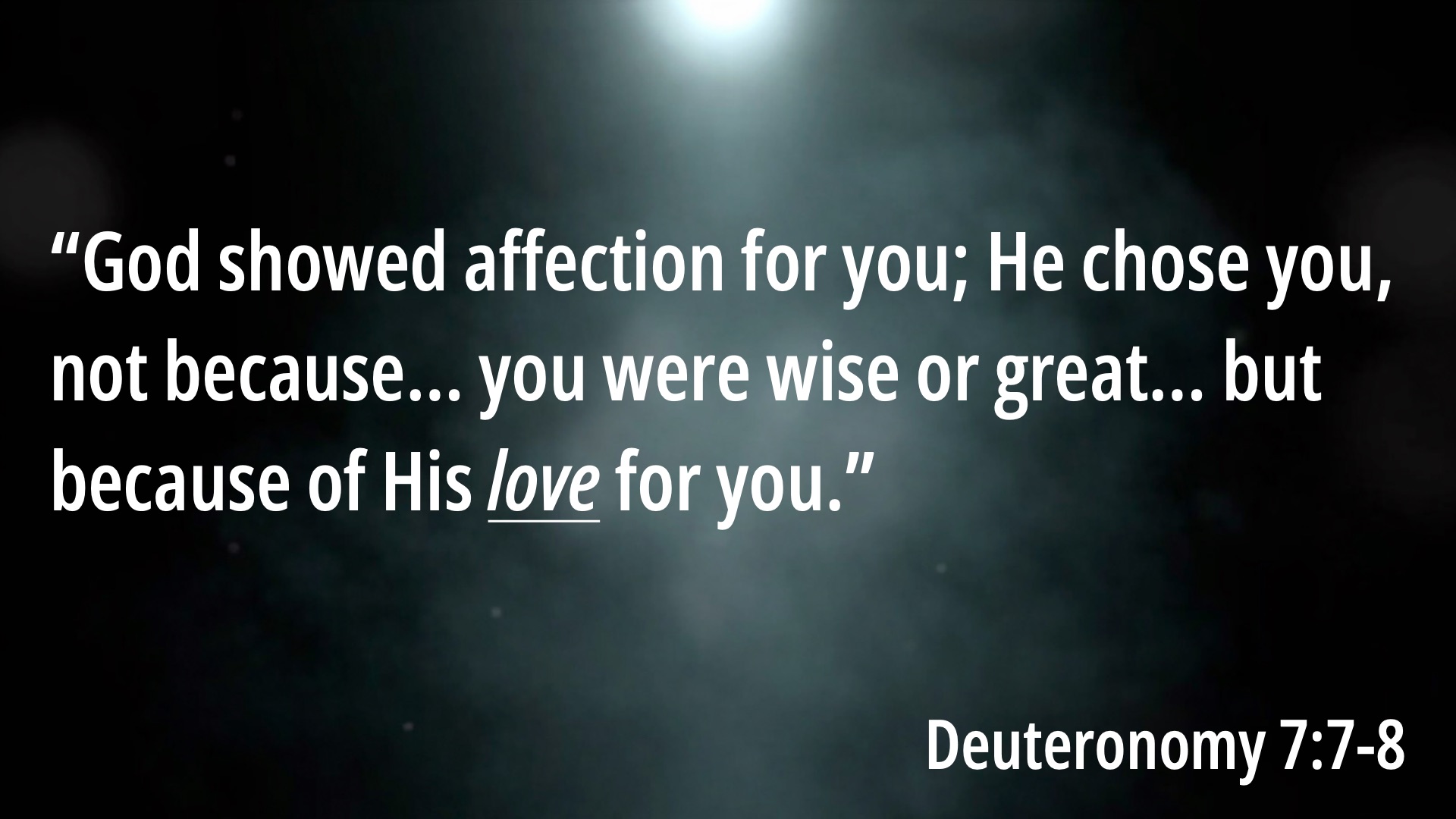
Which brings me to the second thing we need to prepare to live out of this commandment. God is one. And then what we see all over Scripture: God is love. In other words, this is not a mere attribute of God, but it’s of God’s essence and character. In Hebrew the word is Ahavah. And you see in Deuteronomy chapter 7, the very next chapter, these words. Moses tells the Israelites, “God showed affection for you. He chose you not because you were wise, but because great, but because of his love for you.”
God doesn’t love us if we can earn it or deserve it. It simply originates from God’s own character. God loves because God loves. That’s why the prophet Jeremiah calls God’s love everlasting. It has no end because it had no beginning. God’s love is simply an eternal fact of the universe.
And it’s not firstly a duty; it’s actually a delight. So Hosea, another prophet, compares God’s love to spousal love, to parental love—one of the strongest desires that God feels. And yet it also is a duty too. Moses says that God, because he loves you, brings you out of Egypt. So we get in God’s love both a delight and a duty.
So what do we do with that? Well, if God is unrivaled, if God is undivided, if God is worthy of our love, then how do we respond to that love? Well, just like God’s love, human love also shows itself through actions. In the early part of Deuteronomy chapter 10, so just three or four chapters later, we hear about loving God as fearing God, which is to be in awe and wonder of God, of walking in God’s ways, of serving God, of keeping God’s commandments.
And then there’s a crucial thing to note at the end of Deuteronomy chapter 10 and throughout all of the Hebrew Bible, really: our love of God is demonstrated, is validated by how we treat and love and serve other people. So this is what you read in Deuteronomy 10:17 and following:
Deuteronomy 10:17–19 (NIV)
17 For the Lord your God is God of gods and Lord of lords, the great God, mighty and awesome, who shows no partiality and accepts no bribes. 18 He defends the cause of the fatherless and the widow, and loves the foreigner residing among you, giving them food and clothing. 19 And you are to love those who are foreigners, for you yourselves were foreigners in Egypt.
So I’m going to take the occasion to offer some free advice. And so “free” might mean it’s not worth very much to you and you can take it or leave it. But I believe some of us in America today use political excuses to escape theological imperatives. And it would be convenient for me to keep that abstract. But let me make it plain with respect to immigrants and refugees.
Whatever political ideology we espouse does not release us from the God-given mandate to love and serve the marginalized and the ostracized, the alien, the stranger, the foreigner among us. So please advocate politically for whatever convictions you have around immigration. That’s your prerogative, that’s your duty as a citizen. And live a life of love and service to the people around you who need it the most. Identify people in our community who are struggling, who are on the margins, and love them and serve them first.
Love your neighbor as yourself, which is to say with as much ingenuity and creativity and passion as you love yourself, love your neighbor too. So we imitate God’s Ahavah, God’s love, by showing that love to others.
So how do we begin to do that? Well, we’re summoned with the Shema to love the Lord our God with all of our heart, with all of our soul and with all of our strength. What does that look like?
Well, firstly, the heart. Even ancient peoples in this time, they knew that the heart was an organ in the chest. But this is expanded in the Hebrew Bible as the desires of our heart. So this is the center of human experience or human existence. It’s the wellspring of life. So you can think about words like desire, volition, will, affection—which is deeper than emotion.
And Jeremiah, again, the prophet, he knew that ever since we turned our back on God, he believed the human heart was fundamentally broken. So he says, “The heart of a human being is deceitful. It’s irreversibly sick. Who can even understand it or get to the bottom of it?” In our cultural moment, we don’t even try, if we’re honest.
Emily Dickinson famously wrote in one of her poems, “The heart wants what the heart wants.” And Woody Allen and then Selena Gomez and then Cheryl Strayed has used this line as an excuse: “You do you. You got to follow your heart. It’s in charge.” But Moses predicted that if Israel was ever going to love God, well, their hearts were going to have to be circumcised. In other words, the evil would have to be cut out of them, surgically removed, if you will.
In Ezekiel, the prophet would go on to say that God himself would remove the heart of stone and give us a heart of flesh. So you can think about God as a cardiologist performing heart surgery. And we’ve been saying, as we’re talking about every story in Scripture, that every story actually whispers the name of Jesus. And so not only is God a cardiologist performing a heart surgery, but God is also the patient having open heart surgery. That’s a picture of Jesus on the cross.
The story goes that there’s this doctor who had just horrible bedside manner. He was not tender or kind. He had no compassion for his patients. But he all of a sudden changed. He became really tender and very merciful and very kind. And one of his patients worked up the courage to say, “What happened?” And the doctor said, “I got on the table, too. I had the same condition you had. I needed surgery.”
So imagine at the center of our Christian faith, a God who was so heartbroken, he took on our heart sickness. That’s what the gospel is. That Jesus had his heart splayed for us.
So we love the Lord our God with all of our heart. Secondly, with all of our soul. The Hebrew term there is Nephesh, which literally means “throat,” okay? But the Nephesh doesn’t only mean throat. Since the whole body and all of life depend on what goes in and out of your throat—your breathing, your eating—Nephesh also refers to the whole person.
So in the Torah, the murderer is called a Nephesh slayer, and the kidnapper is called a Nephesh thief. So in Scripture, people don’t just have a Nephesh. They are actually referred to as a Nephesh—a living, breathing, physical being, a whole person.
And some of you are thinking, “Well, this is surprising because isn’t the soul the word we use to talk about what departs from the body after we die? And then because of Jesus’ resurrection, it’s one day reunited?” And yes, the Bible talks about that a lot. They just don’t use the word Nephesh.
So we get in Psalm 42, beautiful poetry: “As the deer pants for the water, so my Nephesh pants after you. My Nephesh, my soul thirsts for the living God.” This is beautiful poetry about how our whole physical being longs to know and to be known by our Creator.
So back to the Shema. To love God with all of our Nephesh, with all of our soul, means to devote our whole family physical existence to our Creator. What does that look like? Gratitude. The ability and the willingness to forever and often say thank you. So this is what will change your life. This is what will give you identity and meaning and purpose.
To love the Lord your God, who loves you first, with all of your heart, with all of your soul, and then lastly with all of your strength. Now, the Hebrew word there is me’od, and it shows up 300 times in the Hebrew Bible, and it doesn’t actually mean “strength.” Isn’t that confusing? There’s a perfectly good word for strength in Hebrew, and me’od is not it. In fact, the Shema is one of the only places in the Bible where me’od is translated as “strength.”
So what’s going on? What’s up with that? Well, the most common meaning of me’od is “very” or “much.” So when God created in Genesis 1 and 2, six times it says, “And his creation was good, was good.” And then the seventh time, the number of completion, it was me’od tov. It was very good. So me’od is actually used as an adverb.
So you are to love the Lord your God with your veryness, with your muchness. So let’s review for just a second. We’re called to love God with all of our heart—that is our desire, our affection, our will—with all of our soul—that is our whole life, our physical being—and now with all of our me’od—that is with our muchness. It sounds kind of funny, yet it also rings true, doesn’t it? We kind of get it.
The final thing we use to love God isn’t actually a thing. Everything we devote every possibility, every opportunity, every capacity that we have to honor and love God. It’s the most expansive word in the Shema.
Now, ancient Jewish communities interpreted the me’od of Shema in different ways. So the ancient Jewish scholars that took the Hebrew and translated it into Greek, they used a Greek word for this word called dunamis, where we get the word “dynamite,” which means strength or power. But the Jewish scholars that translated this into Aramaic, they used a word that literally translates into “wealth.”
So I get confused sometimes—or I should say sometimes I get accused of being abstract. So let me get concrete with this. Love God with all of your wealth. Love God with all of your money. So which of these interpretations of me’od is right? Does it mean strength or does it mean wealth? Drum roll, please. It’s the wrong question.
The word me’od doesn’t limit the number of ways we can show our love for God. It’s just the opposite. The point is that everything in a person’s life—every moment, every opportunity, every ability, every capacity—offers a chance to love and honor this one true God who made us. It’s a call to love God with all of our muchness.
Now you think, “Wow, that is impossible.” And so is eating an elephant in one bite. Back to two things: repetition and repetition. To live into meaning that God is one, that God is love, and that God creates purpose in our lives so that one bite at a time, one discipline at a time, one duty at a time, we can learn to love this God with all of our heart and soul and strength.
So I want to conclude by getting to Jesus’ summary, because Jesus actually talked about this. And there’s this legal expert who was out to get Jesus, and so he’s setting a trap. He’s asking a gotcha question: “Rabbi, what’s the greatest commandment?” Now, there were 613 commandments. And so he knew that this would put Jesus in a certain school of thought. He could be scrutinized by his answer.
And this is what Jesus did, who was Jewish, who prayed the Shema every single day. He said, “The greatest commandment is this: Love the Lord your God with all your heart and soul and strength. And the second one is just like it.” And that word means it’s like a photo finish. It’s like a Reese’s peanut butter cup. You cannot have chocolate without peanut butter, and vice versa.
“Love the Lord your God with all your heart and soul and strength, and love your neighbor as yourself. All the law, all the law and the prophets hang on these two commandments.”
I don’t know about you, but have you ever been out and about? Maybe you’re watching a movie or you’re getting coffee with a friend, or you’re out on a date. And you get a text message. What do you do? Well, you look at your watch or your phone. You glance, you check. You don’t want them to see that you’re checking, but you’re going to read that text message. You’re going to find a way to do it.
Well, Jesus takes 39 scrolls and rolls them into a few words that would fit in one tweet, one text message. So what will we do with this? Well, this is what they did with it in verse 9. They write it on the doorframe of their house. Now, some of you will know this word. This became the Mezuzah. And here’s a picture. It became shorthand for this small case on the doorframe. Archaeological excavations found Mezuzahs present in Jesus’ day. So he probably has this in mind as he’s unfurling 39 scrolls into one. He’s saying, “Would you do something significant with this?”
Jesus is speaking to a broken people in a broken world that has given them a counter-commandment: “I should love myself with all of my heart, with all of my soul, with all of my strength, and I should get ahead of my neighbor, ignore my neighbor, blame my neighbor.” And if life sets us up to live out of these two anti-commandments, then Jesus is saying, “No, no, no, no, no.”
What Mezuzah moments should you have in your life? What are you setting up as counter-messages in your life? And I’m done here. But Mezuzah moments—it’s like threshold theology, if you will. Because if it’s on the doorframe every time you’re coming and going, it becomes this moment of spiritual awareness.
So you go out knowing that you’re loved, with an everlasting love. You go out of your house knowing God loves me, God loves others. I should love others too. And then you come back into your house and you’re carrying something: fatigue, frustration, anger, exhaustion. Why? Because it’s hard loving other people. But there’s repetition and repetition to remember again: “No, no, no. This is about who you are and whose you are. In Christ, you are loved. You can love others too.”
I wish I could get more creative with this. As we come to the table, the inner artist in me wanted to end with this, like, spectacularly beautiful poetic moment. This is what I got: Mezuzah’s daily prayer, daily scripture, weekly worship, populating your life with people who remind you that your identity and your meaning and your purpose are grounded in God’s love for you. That’s what Jesus is after. Love the Lord your God with all your heart, soul and strength, and love your neighbor as yourself.
In the name of the Father, Son and Spirit, we pray. Amen.