May 31, 2026
Bart Garrett
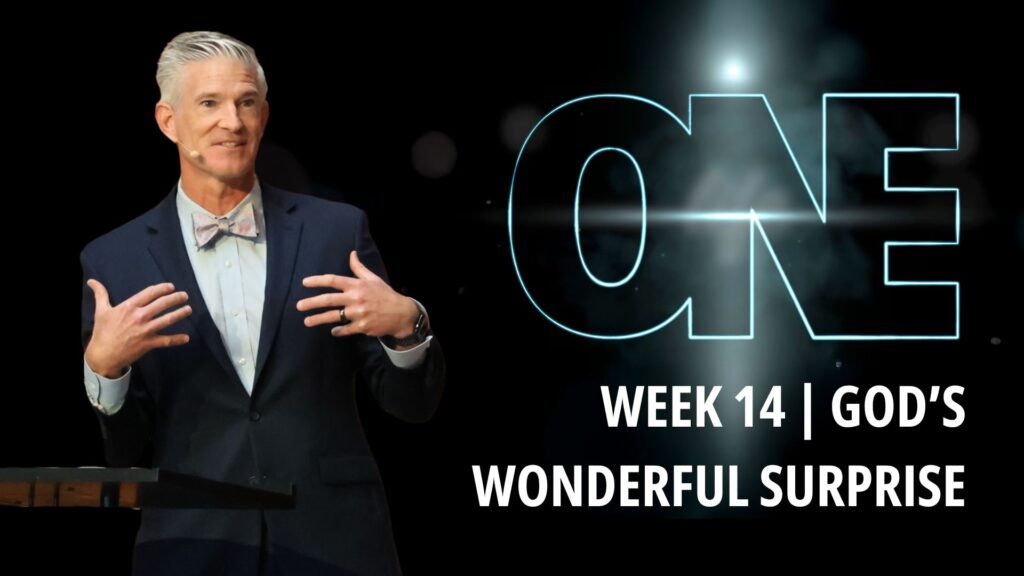
2 Kings 5:1-16
Transcript
Faith Taylor:
Good morning, everybody. Happy Easter. My name is Faith Taylor and I am the director of the Lighthouse, our kids ministry here. And I get to connect children to the truth of God’s great love for them. Our scripture reading today comes from John chapter 20.
John 20:1–2 (NIV)
1 Early on the first day of the week, while it was still dark, Mary Magdalene went to the tomb and saw that the stone had been removed from the entrance. 2 So she came running to Simon Peter and to the other disciple, the one Jesus loved, and said, “They have taken the Lord out of the tomb and we don’t know where they have put him.”
John 20:11–18 (NIV)
11 Now Mary stood outside the tomb crying. As she wept, she bent over to look into the tomb 12 and saw two angels in white, seated where Jesus’ body had been, one at the head and the other at the foot.
13 They asked her, “Woman, why are you crying?”
“They have taken my Lord away,” she said, “and I don’t know where they have put him.” 14 At this, she turned around and saw Jesus standing there, but she did not realize that it was Jesus.
15 He asked her, “Woman, why are you crying? Who is it you are looking for?”
Thinking he was the gardener, she said, “Sir, if you have carried him away, tell me where you have put him, and I will get him.”
16 Jesus said to her, “Mary.”
She turned toward him and cried out in Aramaic, “Rabboni!” (which means “Teacher”).
17 Jesus said, “Do not hold on to me, for I have not yet ascended to the Father. Go instead to my brothers and tell them, ‘I am ascending to my Father and your Father, to my God and your God.'”
18 Mary Magdalene went to the disciples with the news: “I have seen the Lord!” And she told them that he had said these things to her.
This is the word of the Lord.
Bart Garrett:
Thank you so much, Faith. And the answer is no. This is not a clip-on. If we haven’t met yet, I’m Bart Garrett, the lead pastor here, and we are delighted to have all of you here. Everyone is welcome, but some of you, if you think I’m the least deserving, I’m the least likely to be here, then I’m especially glad you’re here because that’s actually the role that Mary Magdalene plays in this story. And we’re just delighted to have you with us this Easter Sunday.
A couple weeks ago, one of our teachers asked our five year olds, why do we celebrate Easter? And Ava said, “Is Easter when we put on costumes and go trick or treating?” Teacher said, “No, that’s Halloween. Anyone else?” And then Liam said, “Oh, it’s when we set off the fireworks.” And our teacher said, “No, no, that’s Independence Day. Anyone else?” And Olivia said, “Well, Easter is when Jesus died.” Our teacher said, “Well, yeah, that’s Good Friday, but what happens to Jesus on Easter that makes it so special?” And Olivia said, “Well, Jesus died and was buried, but every Easter he comes out, and if he sees his shadow, there will be six more weeks of winter.”
So every Easter, every church says, Christ is risen. He is risen indeed. And today we have a wonder truth for our elementary students. As Leong mentioned, they’re staying with us in the service as they do on every first Sunday. And we love having you here. So write this wonder truth down, take it to the connect table after church. You get a prize. But here it is. Three words. Ready? Christ is risen. Christ is risen.
But what does all of this mean? I mean, is it a fairy tale, Jack and the Beanstalk, Harold in the purple crayon, Jesus in the resurrection? Or do people really believe that a human being could conquer death and the grave? And let’s suppose that Jesus did rise from the dead. So what does that even matter today? Two sentiments I want to pack underneath, two questions that we’ll talk about this morning. And here they are. Really? So what? Really? Could he rise from the dead? So what? Why does this matter?
First question. Well, in college, I had my own doubts. I had a season of the dark night of the soul, and the chaplain of the football team said, look, start with the Resurrection. And I wish I had more time to share that journey with you this morning through questions like, was the Resurrection a historical event or was it a later invention? Can I really believe in miracles? Could there be enough evidence to support such an extraordinary claim? And I suppose my career makes it obvious where I landed, but that’s another story.
Today I want to bridle myself to the questions that really come out of this particular text. I want to read the first two verses again. Early on the first day of the week, while it was still dark, Mary Magdalene went to the tomb. And you should know, women had brought spices to prepare the body for the burial. It was hastily done because they were preparing for the Sabbath day. So here they are, and they saw that the stone had been removed from the entrance. So she comes running to Simon Peter and the other disciple, the one Jesus loved, And she says, they have taken the Lord out of the tomb and we don’t know where they put him.
So what’s instructive here is what Mary Magdalene did not say. She didn’t say, Jesus is not here. Christ is risen. Christ is risen indeed. Why not? Jesus had told his followers at least five times that he would rise from the dead. Yet it didn’t even dawn on Mary. Why did she not consider it? Well, at least two reasons. One, no one, and I mean no one, was expecting this to happen. In that world, if you were a Greek or a Roman, the body was considered undesirable and inferior. So your ultimate goal was for your soul to get out of here. So for a resurrection to happen, to come back into the body, that would be like the ultimate downgrade. That would be like sitting in seat 1A in first class and getting relegated to 45F. No one wanted this. And if you were Jewish, there were, yes, some threads of hope woven into this fabric that at the end of time there would be this cosmic resurrection that God would use to heal the world. But one man in the middle of human history? Preposterous.
So firstly, no one is expecting this. Secondly, and more viscerally, it would have been even more difficult for them to accept the resurrection than it is for us today. Why? Because they saw him die. The cross was not just something you wore around your neck, but they saw Jesus wiggle and writhe and strain and gasp, and they even prepared his body for burial. They took off the cold rigor mortis, contorted body from the cross and put it in the tomb. And in that day, there were dozens of failed Messiahs. So if your Messiah was crucified, you would just go find another one. Yet despite every predisposition they had, they met the resurrected Jesus and they sincerely believed. And not only that, they suddenly believed something so stunning happened that they did a complete worldview flip flop. I mean, imagine going to bed tonight a Giants fan and waking up tomorrow a Dodgers fan, which. Wait, that’s the wrong direction. Sorry, sorry. Imagine going to bed tonight a Republican and waking up tomorrow a Democrat. And I’ll let you determine if that’s the right or wrong direction. I’m not touching that this morning. But the point here is that virtually overnight, hundreds of Jewish people became followers of Jesus. They began worshiping a human being as divine, even when their religion instructed them not to. Immediately and instantaneously, these early followers of Jesus set about redesigning their worldview and their characteristic practices and their origin stories and their foundational beliefs around this new fixed point, the Resurrection.
Really? Could it have happened? I think we need to find the most plausible historical explanation in the eminent British scholar N.T. Wright, who wrote 800 pages on that very question. And I’ll leave you to the last thing he said is this. As a historian, I cannot explain the rise of early Christianity unless Jesus rose from the dead, leaving an empty tomb behind him. Are you going to get proofs? No. You can get clues. Are you going to get certainty? No. But you can have confidence. And this fact could end up making the most sense of your life.
Which leads me to our second question. So what? So what if Jesus did rise from the dead? What does that matter to us? Well, in his interaction with Mary, we see that it matters in at least three ways. Because if Jesus is God, if Jesus was resurrected, then we have one, a personal God who can handle our past. Secondly, a personal God who can hold our pain. And thirdly, a personal God who then hands us a purpose. Let’s look at each for just a moment.
Firstly, who is Mary Magdalene? Well, that word Magdalene just means it’s Mary from Magdala. And this is a fishing village on the Sea of Galilee. It had a very loose reputation. There were sailors coming in and out of this little town. And it was said of Mary Magdalene that she was a woman of seven demons and seven lovers. In other words, she was a mess. She was the least likely, seemingly most undeserving candidate to show up at the tomb. And yet here she is. Perhaps she feels guilty over what she’s done. Maybe she feels ashamed over who she’s become. But she meets Jesus and Jesus becomes her friend, and then her rabbi, and then her Lord. And she recognizes that her past did not disqualify her from life with God. Instead, it made her the perfect candidate for God’s grace. When Jesus met her, he did not blush. He didn’t flinch. And that’s true for you. It’s true for me. There’s nothing in your past that makes Jesus hesitate. There’s nothing in your past that Jesus can’t handle. Not your worst decision, not your biggest mistake, not your deepest regret, not the one thing that you hope no one else will ever find out about. Jesus doesn’t just manage your past, he handles it.
How does he do that? Well, deep dive. Put on your theological thinking caps for just two minutes. So far this year, as a church, we’ve been going through this series, ONE. We’re talking about how one book can change our one life in one year. And we’re talking about how Scripture is this pulsating reality that forms precursors and patterns that are always pointing to Jesus. And we see this right here in verse 12, there are two angels that are sitting where Jesus body had been. One at the head, one at the foot. And if you’re a Jewish hearer of this story, you would immediately be thinking of the Ark of the Covenant. If you don’t know what that is, watch Raiders of the Lost Ark. But at the top of the Ark of the Covenant is this mercy seat where these two cherubim are residing. And what happened at the mercy seat was blood from all the sacrifices was sprinkled by the high priest to make atonement, which is totally weird to us in our day. But in their day, in that context, with an elaborate sacrificial system, there were atonement rituals and sacrifices. Even at 3pm on Good Friday, when Jesus breathed his last, that would be the precise time the high priest would bring the sacrificial lamb at Yom Kippur, the Day of Atonement, and sprinkle the blood on that mercy seat. So when Jesus said, it is finished, he was saying that no sacrifice for sin or no human mechanism to deal with our having turned away from God mattered anymore. The killing stopped. Day after day, week after week, year after year, goats, lamb, cow, oxen, it is finished. A once and for all atonement has been made. That’s why the veil of separation when Jesus died for the holy of holies, which separated us from a holy God, was rent from top to bottom. It was Jesus saying, you have access to God again.
So when it comes to your past, might you consider a couple things. One, your own atonement rituals, because we all have them. Our cleansing rituals, where we do good works to follow bad actions. Our liturgical refrains where we say, well, at least I’m not as bad as so and so. Our fasting disciplines, where we kind of vacillate between indulging and refraining and imbibing and resisting. This could point something at in your life. Maybe you are trying to relate to a God who just might be there after all. And a second thing about your past, consider that just maybe your deepest anxiety, your festering anger, your intense exhaustion. And while we have healthy tools out there like therapy, and we should probably all be in it, what if that anxiety, what if that anger, what if that exhaustion is most deeply linked to an assumption that you can actually live your life without God, separated from God, that you could somehow exist without God’s existence in your life. What if you needed a fresh start, a do over? How do you get past your past? Well, this is what Mary Magdalene needed as well, a God who could handle it.
So what? Why does the resurrection matter? Well, if Jesus is raised from the dead, then we have a personal God who can handle our past. But secondly, we have a personal God who can hold our pain. We see in verse 11 that Mary is standing outside the tomb, crying. John doesn’t want us to miss the point. He mentions it five times in these verses, that she’s crying, that she’s weeping. She says, they’ve taken my Lord away. And in the Greek, that’s an emphatic possessive, which is to suggest my loved one. And we know what it’s like to lose a parent or a spouse or a sibling or a child. We lose our compass. We lose our ballast, we lose our balance. And there are tears beneath the tears, and there is sadness beneath the sadness, because Mary is despairing. She is devastated. All that she thought Jesus would do and be. Now her hopes are dashed and her dreams are shattered and her prayers are seemingly unanswered.
And I want to get back to Mary in just a second, but let me talk about you for a second. When you cry, what story do your tears tell? Probably it’s a story that life matters so much that you cannot live without those tears. Probably it’s a story of life beyond the grave. Maybe it’s a story of these very tears pointing to a forever life with God. So back to Mary. In verse 14, she turns around and she sees Jesus, whom she mistakes for the gardener. Of course, her eyes are watery and swollen, and it’s disorienting circumstance. And again, her paradigms could not handle a living Jesus. And so she says to the gardener, please, sir, tell me where you’ve put him. And he says, woman. And I know that sounds harsh, but more so in English. It’s a common refrain here. But imagine he had said, I told you this would happen. Stop crying. It’s me, Jesus. That would have been more harsh, but instead, look how gentle he is. Who are you looking for? Why are you crying? You know, therapists know the best thing you can do if someone is stuck is ask questions so they can access their pain from the inside. The same Jesus who just conquered death is gentle enough to sit with you in your grief and hold your pain.
So what? Why does this matter today? Well, if Jesus was raised from the dead, we have a personal God who can handle our past, a personal God who can hold our pain. And lastly, we have a personal God who will hand you a purpose. In verse 16, Jesus says to her, Mary. And she turns around and cries out in Aramaic, Rabboni, which means teacher. I don’t know about you, but when someone you love and you admire, when they say your name, it captures your attention, it draws you in and this is the moment where Jesus hands Mary a purpose. Go tell my brothers about this. So don’t miss this point. Mary had turned toward him, and in the one second that that turn took, imagine the world shifting ever so slightly on its axis and history moving almost imperceptibly from BC to AD. One second before this turn, there’s this woman in deep despair over losing her loved one in this world. And then one second after this turn, there this woman experiences her grandest hope for the next world, a death conquering savior.
In verse 17, this is an exchange we find confusing, so it warrants a little explanation. Jesus says, don’t touch me. Hands off. So what happened to the warm, tender, welcoming Jesus? Well, he literally is saying, here, don’t hold me so tight. There’s still work to do. There’s still a mission to complete. There’s still a purpose I’m handing you. So to unpack this purpose, I want to end with where our story begins. The very first verse reads this on the first day of the week. What’s the significance of that? Well, John, who wrote this story about Jesus, his gospel is often called the new Creation Gospel. In fact, the book of Genesis at the very beginning of the Bible starts with the words in the beginning, when God created the heavens and the earth. John starts his gospel in the beginning. So what he’s saying is that Jesus being laid in the tomb the last day of the last week of the old creation, and his resurrection is the first day of the first week of the new creation. So if the cross is the last chapter of the old world and the empty tomb is the first chapter of the new one, if the resurrection isn’t just a happy ending, but a startling new beginning, then we are handed a purpose. We’re invited to ask the question, how is my life today being rewritten right now? To ask questions like what parts of my life don’t belong? What will not last and simply buckle under the weight of eternity, what might wither away as the thorns and the thistles of the old creation and not the buds and the blossoms of the new one? What fears and anxieties in my life should recede further into the backdrop as merely old world problems?
When the resurrected Jesus calls you by name, he’s calling you out of the old stuff and into the new stuff. It doesn’t mean life becomes easy. The vestiges of the old world still creep in, but it’s discontinuous with what will be. This is the purpose that Jesus hands you, to practice his resurrection every day, to live into the hope that all suffering is temporary and all joy is eternal. To summon the bold confidence to say, none of my pain or the sufferings and injustices of this world will have the last word. The last word that will reverberate into a new creation, a new order, a new cosmos is our wonder truth. Kids. Christ is risen.
So, in conclusion, I want to speak directly to two of you in this room, two groups of people, the really people and the so what people. If you’re a really could it have happened person. Comedian Jim Gaffigan says Easter is the time to throw all caution to the wind and put all of your eggs into one basket. So maybe this is a season for you to put all of your eggs in the Christianity basket. I’m offering it as a three, two, one challenge for you. You’re gonna hear more about a conversation we’re having starting tomorrow night with dinner called Questioning Christianity. We’re gonna do it for seven weeks. If that’s you, would you consider coming to three of those over the next seven weeks? If this is you asking the really question, this is Easter season, so the next six or seven Sundays, would you consider coming to two of those Sundays and just trying on Christian faith and seeing if it fits? Would you find that one friend or neighbor who’s a Christian, and would you just ask them the question, why do you believe what you believe? If you don’t have a Christian friend, come talk to the pastors here. We love these conversations.
Now, also, when you’re considering Christian belief, would you consider the coherence of your own beliefs? Because even if you don’t believe in God, you already believe in at least three resurrections, three life from death moments. That everything came from nothing. That order came from chaos, that life came from non life. And if you already believe in those three resurrections, what’s one more to believe in?
Secondly, to the so what people? Could this really matter to me? Well, yes, it can. If Jesus can handle your past and hold your pain and hand you a purpose, if Jesus Christ rose from the dead, then everything in your life is going to be all right. There’s hope that runs deeper than six feet under. There’s next life hope that believes. Every laugh here will grow heartier there. Every tear here will be wiped away there. That every conversation here is merely an ellipsis, that every loved one lost will be found in Christ. This is the hope premised upon our wonder truth, kids. Christ is risen. He is risen indeed. In the name of the Father, Son and Spirit, Amen.

Subscribe to one or more of our newsletters.
*Our newsletters are either weekly or monthly. We promise we won’t flood your inbox.
1801 Lacassie Ave.
Walnut Creek, CA 94596
Want to contact a specific staff member?