
December 28, 2025
Brian Kay
Luke 2:25-35
Home / Sermons / Plot Twist / Shepherds
Transcript
Matt Doherty:
Well, hello, everyone. My name is Matt Doherty. This is Rachel Ingram, and we are co-directors of the student ministry here at WCPC, which means we help middle and high school students connect to Jesus through our youth ministry called the Harbor.
Melinda Kawashima:
And I’m Melinda Kawashima. I connect new people to our church here. We’re so glad that you have joined us tonight. You know, since the 16th century, Christians have been marking the four weeks of preparation for Christmas with the lighting of the Advent candles. We remember the many years that the family of God waited for the promised arrival of Jesus the Messiah.
Matt Doherty:
Hear these words from the prophet Isaiah. Isaiah 9, verses 6 through 7.
Isaiah 9:6–7 (NLT)
6 For a child is born to us, a son is given to us. The government will rest on his shoulders, and he will be called Wonderful Counselor, Mighty God, Everlasting Father, Prince of Peace. 7 His government and its peace will never end. He will rule with fairness and justice from the throne of his ancestor David for all eternity. The passionate commitment of the Lord of Heaven’s armies will make this happen.
Rachel Ingram:
We lit these candles for hope, peace, joy and love. And now, after weeks of waiting, we now light the Christ candle, symbolizing his birth. And now our scripture reading for tonight comes from the Gospel of Luke, chapter 2, verses 8 through 20.
Luke 2:8–20 (NIV)
8 And there were shepherds living out in the fields nearby, keeping watch over their flocks at night. 9 An angel of the Lord appeared to them, and the glory of the Lord shone around them. And they were terrified. 10 But the angel said to them, “Do not be afraid. I bring you good news that will cause great joy for all the people. 11 Today in the town of David a Savior has been born to you; he is the Messiah, the Lord. 12 This will be a sign to you: You will find a baby wrapped in cloths and lying in a manger.”
13 Suddenly a great company of the heavenly host appeared with the angel, praising God and saying,
14 “Glory to God in the highest heaven,
and on earth peace to those on whom his favor rests.”15 When the angels had left them and gone into heaven, the shepherds said to one another, “Let’s go to Bethlehem and see this thing that has happened, which the Lord has told us about.”
16 So they hurried off and found Mary and Joseph, and the baby, who was lying in the manger. 17 When they had seen him, they spread the word concerning what had been told them about this child, 18 and all who heard it were amazed at what the shepherds said to them. 19 But Mary treasured all these things in her heart and pondered them. 20 The shepherds returned, glorifying and praising God for all the things they had heard and seen, which were just as they had been told.
Melinda Kawashima:
This is the word of the Lord.
Bart Garrett:
Well, thank you guys and Merry Christmas everyone online as well. If we haven’t acknowledged you yet, we’re glad you’re here with us. I’m Bart Garrett and it occurred to me as all of our other staff are introducing themselves and connecting to what they do, I had forgotten to do that. So I asked my 19-year-old Cami when she was 4 what I did. I tried to explain it and she said, “So you’re the bossy man that stands up in front of everyone and tells them what to do.” So I guess that’s what I’m doing for our next few brief moments together. Not that, but this is actually one of my very favorite moments of the year and I’m just delighted to share it with you.
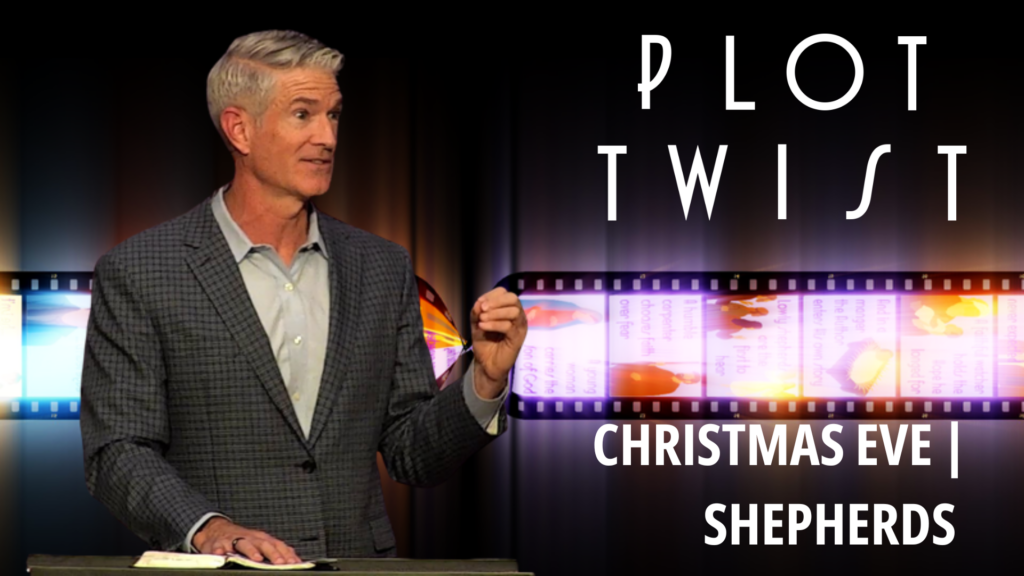
And as you notice from our title sequence, we’re in this series over the past few weeks called Plot Twist and we’re looking at how God turns the world upside down through a plot twist. How a lot of the characters in the story have plot twists. How you have so many plot twists in your own life. And it got me thinking and wondering, who is it that shows up at a Christmas Eve service?
And maybe you’re here experiencing joy and anticipation this time of year. Others of us are discouraged and distressed, maybe even depressed. Some of us are heartbroken and grief-stricken because we’ve lost someone we love or there’s an empty space at the table. Maybe you’re in a fractured, jagged relationship and it’s felt acute. It’s felt more acutely this time of year. I know there are people who are guilt-ridden in the holiday. There’s a lot of regret. That’s kind of holiday-charged. Some of us are just on the fringes of faith if we’re honest, where skeptical, maybe even cynical of the Christian faith. Maybe you’re here and you’re just a little bit more apathetic this time of year. Just give me the candles, the carols, the cocoa, the Christmas trees, the cookies, everything else that starts with C but the Christ of Christmas really.
Also, I know there are people here who are reunited as families. College students are back, grandparents are in town, aunts and uncles are here. Some of you are here to respond to a family member. Some of you are here to spite a family member. Some of you are sad because in-laws couldn’t make it this year. Some of you are relieved because in-laws couldn’t make it this year. Maybe you’re a friend or a neighbor or a coworker. And you’re just here because your friend or neighbor or coworker just keeps inviting you to church. And here you are to appease them. Maybe you are in a last-ditch effort to find God, hopefully in a room this size. I didn’t miss anyone.
But I want to offer a word to everyone here this evening. As a person of faith, I do not think it is an accident that you’re here. This very stitch in time, this space we share at this very moment together. I don’t believe there are accidents. And I would also like to say to you, all of you are welcome here. In fact, God’s message to the angels at Christmas is good news of great joy for all people and all really means you. Rich, poor, man, woman, trans, gay, straight, black, white, brown, single, married, introverted, extroverted, outsider, insider, skeptical, convinced, churched, unchurched, dechurched, rechurched, over-churched, under-churched, Republican, Democrat, Whig, Tory, all of you are invited to consider this message.
In fact, kids, it was so great having you up front. I’m especially glad you’re in our midst. We love having our elementary students here. And you can help me out for just a second. Have any of you ever acted out the Christmas play, the Nativity story? Yes. I see a lot of hands going up. So who are some of the best characters in the story? Here’s an example for you. Who we got here? Yes. Mary and Joseph. Fun to play Mary and Joseph. You can’t play the baby Jesus because grownups call that blasphemy. But here’s another one, Angel Gabriel. She’s always a fan favorite. Right? Here’s another one who’s been a wise man. Yeah, the wise man. How great is it to give gifts of gold and frankincense and myrrh?
But do you know who features most prominently in the Christmas story? Who the central figures are. In fact, if you were to ask the author of this story, Luke, who we should be paying attention to in the story? Are you ready for this? No one’s ready for this. It’s the shepherds. In fact, this kid who’s wearing the red Converse would rather play the camel’s butt than be a shepherd. These shepherds you see here, they look really happy, but they’re really just hiding their envy because they didn’t get to be Mary and Joseph. And their family is sitting in the audience wondering if their shepherd kid is going to turn out okay because they just get to play the shepherd.
And I really hope this is a stock photo or I’m going to get some emails in just a moment. But the Christmas story that is barely longer than two paragraphs mentions the shepherds not once or twice, or three times, or even 10 times, but 23 times. And in that day, scrolls were costly and the space was limited and word economy mattered immensely. And Luke mentions where the shepherds were, fields nearby, what they were doing, keeping watch over their flock at night, how they felt—they were terrified. Or another older translation, sore afraid. Or as we might say in the South, scared manureless.
And if you’re skeptical of God, if you’re cynical of the church, I recognize that I am flitting right past an entire choir of angels as if I had wings. And you’re thinking, how convenient. This guy isn’t even going to talk about the angels. But by way of defense, I gave a whole sermon on the angels a week ago. You can listen to the podcast if you’re interested. But suffice it to say, angelic sightings are very rare. And they are always paradigm busters. No one is expecting them. I mentioned then you could imagine this angel training manual. And it starts with, when you’re approaching the humans, don’t startle the humans. They’re going to freak out, they’re going to stutter, they’re going to wet themselves, they’re going to fall face down. The first thing you need to say to them is, don’t be afraid.
But back to the shepherds, Luke goes on, and he writes what is said to them. Good news. How they responded. Let’s go to Bethlehem. How they went. They hurried off. How they responded to Jesus. They spread the word concerning what they had been told. How people responded to their responding. All who heard the shepherds were amazed. And if all of this is not proof enough of the shepherd status in the story, Luke concludes the narrative not with Mary’s treasuring and pondering everything in her heart, but with shepherds returning to the fields, glorifying and praising God for all that they had heard and seen.
So now, if you could experience this story afresh, anew, maybe for the first time, through the eyes and the noses and the fingernails and the sandals of a shepherd. Then you might consider afresh, anew or for the first time, two answers to two questions that I believe every single one of us is asking at some point, albeit wittingly or unwittingly. And here are the two questions. What is God up to? And how is God up to it? What is God up to? That’s a message question. And how is God up to it? That’s a medium question.
If you’ll allow me to be a cultural geek for just a second. Social critic of the last century, philosopher Marshall McLuhan used to say, the medium is the message. So if you think about the television for a second, what’s on the television set, that’s the message. But when the TV was rolled into the family room, everything changed. Families moved from the kitchen table to TV dinners, which you’ll remember, some of you, the Swanson TV dinner, even shaped like a box like a TV. Then Ronald and Nancy Reagan, picture of them eating on TV trays, just bringing the family around this television set. Bookshelves became family entertainment systems. We used to put—when the flat screen came out, we put the flat screen over the fireplace. Now we put the fireplace in the flat screen. Go to Netflix, find your favorite fireplace of Q.
The cultural geek out that you’ve just allowed me is to say this. The medium is the message. Or for our purposes, at the very least, the medium. The shepherds matter in the receipt of the message. What is God up to? How is God up to it? You can’t really separate these two. So I want to spend just a moment on each of them.
What is God up to? Again, this is the message. And it is this. Are you ready for it? Salvation. Good news of great joy for all people. A savior. Who is the Messiah? The Lord. Now, I took a graduate school course on that one sentence, and I’m not making this up. So I only want to circle one word tonight. It’s the word savior that we need a savior, that we need to be saved from something. And that word salvation, before it sprouts wings and flies away. The word in Greek is sozo, which can mean healing, that we need to be healed, that we need to be rescued. And you might be thinking at this point, how is this good news that I need to be saved, that I need to be rescued? Frankly, I feel I’d do better with a personal assistant or a therapist or a life coach. At least they would be helpful. And they would be, and they are. Yet none of those folks can ultimately rescue you from you, because as the saying goes, wherever you go, there you are.
There’s this anthropological debate that’s been going on as long as anthropology has been a discipline. Are human beings innately good or are they innately bad? And Christian scripture says it’s not either or, it’s actually both. That a good world has gone bad, a beautiful world has been broken. And Scripture says this is because sin has entered into the world. And you hear that word sin, it’s like, oh, this is the word we hear in church. A couple weeks ago, I used a helpful Latin phrase that I’ll use again here. Augustine said that we are homo incurvatus in se. We are human beings who are turned inward upon themselves. And I asked if you’d ever been to a county fair house of mirrors, and many people raised their hands and you know, the concave and the curvature designs of those mirrors, what do they do? They bring distortion and confusion, and you feel lost in that fun house. This is just a little picture of what it means to turn away from God, to turn inward upon ourselves and to experience life that can be distorted and confused and in some ways can feel as if we’re lost.
And Christian faith acknowledges that self-help can help, but it cannot fully heal because you cannot heal yourself. You cannot rescue yourself, but you can be rescued. That’s what salvation is all about. Good news of great joy for all people. That all of us are together in this predicament. So the people of God in that day were saying, oh, God, save us from the Romans. And many of us in our day are saying, oh, God, save us from those people over there, whoever they are. And God is saying, let me start by saving you from yourself.
This is where the rest of scripture actually takes a huge plot twist towards forgiveness. In fact, forgiveness shows up far more in the New Testament, the Greek scriptures than it does in the Hebrew scriptures, the Old Testament, seven to ten times more. And it’s deeply personal and it’s relational. So here’s a thought experiment for you. Think about that one person in your life that you don’t like very much. Some of you are saying, I like everyone. You’re liars. Others of you are saying, one person, really. At least you’re being honest. But you’re probably thinking about that one person who has wronged you. And that’s okay. That’s what I want you to do in this thought experiment. But say over time you develop the capacity to forgive that person. It doesn’t mean it’s cheap or easy. In fact, it’s massively expensive and difficult because a debt must be paid. Pain must be worked through, anger must be melted down. Maybe bitterness that you’ve clung to as your precious has to be overcome.
So what if it cost God so much more than we could ever conceive because of how wrong we were? What if our turning away from God and turning inward upon ourselves detonated a bomb that sent shrapnel all the way into God’s cosmos. That’s what the early followers of Jesus had to wrestle through and accept. And one of them, Paul, who actually used to kill Christians for sport, became one. And he wrote clearly on forgiveness to the early church in Colossae. And this is what he wrote.
Colossians 1:19–22 (NIV)
19 For God was pleased to have all his fullness dwell in him, 20 and through him to reconcile to himself all things, whether things on earth or things in heaven, by making peace through his blood, shed on the cross. 21 Once you were alienated from God and were enemies in your minds because of your evil behavior. 22 But now he has reconciled you by Christ’s physical body through death to present you holy in his sight, without blemish and free from accusation.
Now, today, in the 21st century, we might bicker with the means of this reconciliation. A cross. Is it a torture device? How primitive. You should know. I spent a year and a half working through those questions myself. But suffice it to say here, true reconciliation involves real forgiveness. And real forgiveness always costs something, and often it’s a lot. That’s the message of what God is up to. So some of you may be struggling with it. So let’s take it to our last couple minutes to the medium.
How is God up to it? How is God up to this salvation message? The answer is subversively. In a broken world, God says, you did the breaking, so you need to be saved, you need to be rescued, you need to be healed, you need to be forgiven. Now, what is the best medium for that message?
In 1998, there was a God Speaks billboard campaign. It was largely in the South. This was one of them. “Don’t make me come down there.” No, he did, but that’s the story. As much as that campaign might ruffle our sensibilities, I wonder how we would do today if we were thinking of ourselves in the story 2,000 years ago and we showed up as God’s PR director, as God’s brand manager, and we said, no, God, I want you to sit down here because I want you to think big. Two thousand years from now, we want three quarters of the human race to know your name. We want a third of the human race to center their entire lives around you personally. We want your body of teaching to be the most famous body of teaching in all of human civilization. So what are we going to do? We’re going to bring in some consultants, some entrepreneurs, some investors. We’re going to get around the economic engines and the media savvy and the political power and the academic intelligentsia and the social media influencers. And God says, how about if I do it this way. I’ll share this message to shepherds and not the Victorian pipe-playing, sturdy, wholesome country boys who are honest-looking, square-jawed with ruddy complexions. We’re talking about the people of the land, the invisibles, outcasts on the outskirts, the socially marginalized, the economically fragile, the religiously ostracized. I could not overstate how down and out ancient Near Eastern shepherds were. Think today. Day laborers, migrant workers, transient drifters. Thank the Home Depot parking lot, local tent encampments.
God chose to deliver the message of salvation subversively, seeking to undermine and topple and unsettle and destabilize the world’s established power structures. God bypasses the religious establishment in Jerusalem. God bypasses the political machine in Rome. God informs shepherds. These are the last people anyone on the planet would have imagined would receive this message from God.
But wait a second. As we close, you said that God’s message that I need to be rescued would be made more palatable by this medium, the shepherds. But this actually seems less appealing to me. Okay, so maybe your struggle with marrying the medium to the message is the actual proof that you need this message. Because we all do. If our hearts bristle at God giving power to the powerless and granting access to those who have none, then maybe that’s the indicator that we might need to be rescued after all, to be forgiven and reconciled in a way that will allow us to forgive and reconcile. If you let the medium critique and challenge you, then the message might just grab you afresh and anew. Or for the first time, or for the first time in a long time.
That God would come in vulnerability. That’s the great plot twist. That the author of the story would become a character in the story. That God would enter history’s grand stage as an embryo. Fragile, susceptible, vulnerable. That the infinite would become finite. That the creator of the universe would become a single cell, born to teenage parents. Born in a stable, lying in a feed trough in a one-stop light town. Born as a marginalized Jew in a Roman world. A message of salvation delivered subversively to shepherds. Good news of great joy for all people. And by all I mean you too.
For unto you is born this day in the city of David, a savior who is Christ the Lord. Amen.
Subscribe to one or more of our newsletters.
*Our newsletters are either weekly or monthly. We promise we won’t flood your inbox.
1801 Lacassie Ave.
Walnut Creek, CA 94596
Want to contact a specific staff member?